
You are using an out of date browser. It may not display this or other websites correctly.
You should upgrade or use an alternative browser.
You should upgrade or use an alternative browser.
- Status
- Not open for further replies.
AW IMR 18350/490/650 batteries, come highly recommended.

AW brand seems to have the best reputation on this forum. I use the IMR version in both my VV and mechanical mods, I just believe they are a safer battery than the ICR protected ones. I've also read good things about the Panasonic and Efest batteries.
I recommend buying your batteries from a trusted source such as RTD Vapor. Pila and Xtar are good choices for chargers. I also recommend using plastic battery cases if you carry spare ones with you. All are available at RTD.
I recommend buying your batteries from a trusted source such as RTD Vapor. Pila and Xtar are good choices for chargers. I also recommend using plastic battery cases if you carry spare ones with you. All are available at RTD.
Last edited:

Recently I bought a few Panasonic CGR18650CH hybrid batteries, for my vv Gripper, and I like them. Ebay normally has all major brands at really good prices and free shipping 2X New Panasonic CGR18650CH CGR18650 3 6V 2200mAh Li ion Battery One Free Box | eBay
Last edited:

Definitely go with IMR batteries. AW IMR, Panasonic CGR18650CH hybrid and MNKE IMR all have great reputations. The Panasonics offer 2200 mAh and the MNKE's may have a slightly higher max discharge rating. Whichever you decide on, Baditude's advice on where to buy and on chargers is right on.
Also, get a digital multi meter and if needed learn how to use it for resistance testing and battery voltage. Use it regularly. If you have a shorted coil, the battery will short and that's BAD. Don't over discharge the batteries. I try to take mine out at 3.5 volts. Yes, you can go lower, but don't forget there is a voltage drop in use and aiming for 3.5v gives me a bit of room for error.
Also, get a digital multi meter and if needed learn how to use it for resistance testing and battery voltage. Use it regularly. If you have a shorted coil, the battery will short and that's BAD. Don't over discharge the batteries. I try to take mine out at 3.5 volts. Yes, you can go lower, but don't forget there is a voltage drop in use and aiming for 3.5v gives me a bit of room for error.

I would disagree. If you dead short one of your AW IMRs you better hope something gives to break the connection. Those things get awful hot. A protected battery on the other hand offers 3 levels of safety. The PCM prevents over discharge, over charging and in the event of a dead short it trips within seconds. Your AW IMRs have none of these built in protections.AW brand seems to have the best reputation on this forum. I use the IMR version in both my VV and mechanical mods, I just believe they are a safer battery than the ICR protectect ones..
You saw by now ECF's Old Soldier pic of a shorted AW IMR18650 battery.
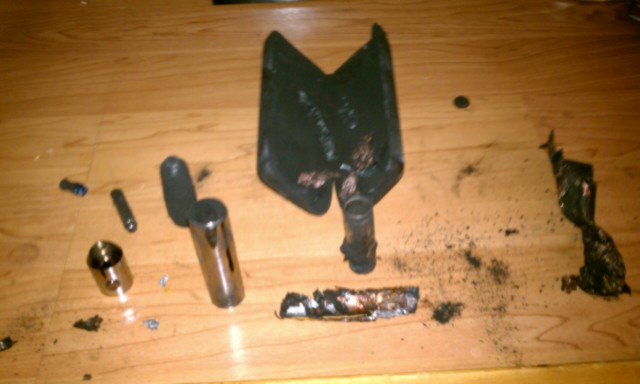
A protected battery's PCM would have tripped long before that could have happened.

Personally, I ilke protected AW ICR batteries in mechanical mods, and AW IMRs in mods with circuitry (circuitry has protection).
This just makes sense to me.
This just makes sense to me.
Well, I had a protected ICR battery do nearly the same thing in a mechanical mod. I was lucky to find it before a fire occured. It could be that Trustfire just isn't a quality/safe battery.I would disagree. If you dead short one of your AW IMRs you better hope something gives to break the connection. Those things get awful hot. A protected battery on the other hand offers 3 levels of safety. The PCM prevents over discharge, over charging and in the event of a dead short it trips within seconds. Your AW IMRs have none of these built in protections.
You saw by now ECF's Old Soldier pic of a shorted AW IMR18650 battery.
A protected battery's PCM would have tripped long before that could have happened.
View attachment 201603
Last edited:

Protected Vs. Unprotected Batteries
Any mod which doesn't have some sort of originally manufactured protection system MUST be used with "protected batteries". And Mech. Mods r one such. It has nothing to safeguard us against probable/possible malfunctions... it's just a tube holding a powerful electrical device(!), a very powerful one... yes 18650 is, it can blow our face off! And I'd definitely not want that time-bomb right on my face!
That said, most "unprotected batteries", at least the ones made by manufacturers worth their salt, will have some sort of protection, else they wouldn't offer them OTC (over-the-counter). So, they may be used in our Mech. Mods, but under considerable risks. That goes true for the "Chemically Safe" batteries as well. However, none of these r "fully" protected to offer us the requisite peace-of-mind. See below:
--------------------------------------------------------------------------------------------------------------
A "protected battery" will typically be produced with the following four (4) safety features:
1. A PTC (Pressure, Temp., Current) Switch. This protects the output of the battery against high-pressure, over temperature and unusual draw of current. It cut's-off the output in such a scenario and also automatically resets when all's clear.
2. A CID (Circuit Interrupt Device). Which, basically is a pressure valve AND is collocated with the PTC. It 'opens' the electrical path if an over-charge raises the internal cell pressure to 1000 kPa (145psi).
3. A Safety Vent. It's usually a hole at the bottom of the +ve post that releases gas (CO2, vaporized electrolyte and other combustive gasses) in the event of a rapid increase in cell pressure or a chemical malfunction.
4. A PCB (Protection Circuit Board). In addition to the above three internal safeguards, an external electronic protection circuit unit (looks like a round PCB) prevents the charge voltage of any cell from exceeding 4.30V. Furthermore, a fuse cuts the current if the skin temperature of any cell approaches 90°C (194°F). To prevent the battery from over-discharging, a control circuit cuts off the current path at about 2.20V/cell. It also resets automatically once the snag has been overcome.

NOTE: Unprotected batteries will have at least two (2) of the above protections, viz. the PTC and the Safety Vent. While a reputed manufacturer would also incorporate the CID. But, I repeat, 'but' they WILL NOT have the PCB. Which is the last & final protection level and is ONLY available in the Protected Batteries.
--------------------------------------------------------------------------------------------------------------
Remember, "Safe Chemistry" is just SAFE to an extent... but it's Not SAFEGUARDED. Which is why it definitely makes sense to place only "Protected" Li-Ion Batteries inside our Mech. Mods, whatever mAh / size we may select. It is pertinent to also note here that every Mod retailer will always mention that in their listing, viz. "pls use only protected batteries with this mod"*.
So, will I divert? -Nah
They r pretty inexpensive too... see here. This is from where I get mine.
_______________________________________________________________________
*So far so that one of the vendors (CanVape) relegates us being stupid for heading otherwise. Tad harsh, but that's what their website states:
Any mod which doesn't have some sort of originally manufactured protection system MUST be used with "protected batteries". And Mech. Mods r one such. It has nothing to safeguard us against probable/possible malfunctions... it's just a tube holding a powerful electrical device(!), a very powerful one... yes 18650 is, it can blow our face off! And I'd definitely not want that time-bomb right on my face!
That said, most "unprotected batteries", at least the ones made by manufacturers worth their salt, will have some sort of protection, else they wouldn't offer them OTC (over-the-counter). So, they may be used in our Mech. Mods, but under considerable risks. That goes true for the "Chemically Safe" batteries as well. However, none of these r "fully" protected to offer us the requisite peace-of-mind. See below:
--------------------------------------------------------------------------------------------------------------
A "protected battery" will typically be produced with the following four (4) safety features:
1. A PTC (Pressure, Temp., Current) Switch. This protects the output of the battery against high-pressure, over temperature and unusual draw of current. It cut's-off the output in such a scenario and also automatically resets when all's clear.
2. A CID (Circuit Interrupt Device). Which, basically is a pressure valve AND is collocated with the PTC. It 'opens' the electrical path if an over-charge raises the internal cell pressure to 1000 kPa (145psi).
3. A Safety Vent. It's usually a hole at the bottom of the +ve post that releases gas (CO2, vaporized electrolyte and other combustive gasses) in the event of a rapid increase in cell pressure or a chemical malfunction.
4. A PCB (Protection Circuit Board). In addition to the above three internal safeguards, an external electronic protection circuit unit (looks like a round PCB) prevents the charge voltage of any cell from exceeding 4.30V. Furthermore, a fuse cuts the current if the skin temperature of any cell approaches 90°C (194°F). To prevent the battery from over-discharging, a control circuit cuts off the current path at about 2.20V/cell. It also resets automatically once the snag has been overcome.

NOTE: Unprotected batteries will have at least two (2) of the above protections, viz. the PTC and the Safety Vent. While a reputed manufacturer would also incorporate the CID. But, I repeat, 'but' they WILL NOT have the PCB. Which is the last & final protection level and is ONLY available in the Protected Batteries.
--------------------------------------------------------------------------------------------------------------
Remember, "Safe Chemistry" is just SAFE to an extent... but it's Not SAFEGUARDED. Which is why it definitely makes sense to place only "Protected" Li-Ion Batteries inside our Mech. Mods, whatever mAh / size we may select. It is pertinent to also note here that every Mod retailer will always mention that in their listing, viz. "pls use only protected batteries with this mod"*.
So, will I divert? -Nah
My topmost selection/s for a Protected 18650 battery:
1. Panasonic Protected NCR18650A Rechargeable 3100mAh 3.7V
2. Panasonic NCR18650B Protected Rechargeable 3400mAh 3.7V
3. Sanyo UR18650F 18650 2600mAh Protected Rechargeable
4. Sanyo UR18650ZT 18650 2800mAh Protected Rechargeable
5. Samsung ICR18650-30B 18650 3000mAh Protected Rechargeable
6. Samsung ICR18650-26F 18650 3.7V 2600mAh Protected Rechargeable
They r pretty inexpensive too... see here. This is from where I get mine.
_______________________________________________________________________
*So far so that one of the vendors (CanVape) relegates us being stupid for heading otherwise. Tad harsh, but that's what their website states:
"If you use unprotected batteries with this mod you are stupid and we cannot be held responsible for any personal or property damages that may result from your ignorance."[Unquote]. Pls see here.
Sorry if I am interrupting this thread, but can someone please provide the link to a retail vendor whom in the eyes of the community carries the best "In-Line" voltage meter (ie. screws on top of the mod with the atomizer in turn screwing on top of the meter)?
Thank you so much
Thank you so much
I would disagree. If you dead short one of your AW IMRs you better hope something gives to break the connection. Those things get awful hot. A protected battery on the other hand offers 3 levels of safety. The PCM prevents over discharge, over charging and in the event of a dead short it trips within seconds. Your AW IMRs have none of these built in protections.
You saw by now ECF's Old Soldier pic of a shorted AW IMR18650 battery.
A protected battery's PCM would have tripped long before that could have happened.
It's not that simple WillyB. I've been researching this in prep for my first mechanical mod. Most suppliers say do not use unprotected batteries in a mech mod. Then they offer IMR batteries in a pull down menu and/or say their preferred battery is a AW IMR, both of which do not have protection. I asked one supplier and they told me that lion refers to Li-Co batteries, but that IMR chemistry is safer and what they prefer.
This is from Rolygate on battery safety here:
"Our advice is that the best and the safer choice of battery for APVs is the AW IMR Li-Mn rechargeable.
It is a safer-chemistry battery that needs no protection, and has a high-discharge rating meaning that it is safer to use with high-current devices such as atomizers.
It is thought that the best option is the largest AW Li-Mn battery that can be fitted (this is partly due to the fact that the supply chain can be verified if due diligence is used)."
"We now advise that Li-Mn or top-quality Li-FePo4 rechargeables are used in APVs, in preference to rechargeable Li-ions. We suggest the best option, in order, is:
1. AW IMR Li-Mn rechargeables.
2. AW Li-FePo4 rechargeables [Li-FePo4's MUST HAVE A SPECIAL CHARGER]. Note that these batteries are mostly 3 volt nominal so the system voltage will be lower than normal.
3. Good quality (such as AW or Pila) protected Li-ion rechargeables.
4. Branded protected Li-ions come next - such as xxxfire Li-ion rechargeables (for xxx insert Trust / Sure / Ultra-).
5. The least-preferable option is a generic protected Li-ion.
6. Unprotected rechargeable Li-ion cells should not be used.
7. Standard cells (non-rechargeable) should not be used."
"Because the protection circuit on a protected Li-ion battery can fail, an Li-Mn or good-quality Li-FePo4 is intrinsically safer."
My take is that protected Li-Co are safe as long as the protection system works. If that fails and a PV problem is encountered, they get dangerous at reasonably low temperature, so quickly. They are also only good to about 4 - 5 A discharge, someone please correct me if I have this number wrong. Not that much lee-way for shorts possibly encountered while setting up a RBA coil. Not viable for sub 1 ohm coils.
IMR or hybrid batteries with no protection are susceptible to over-discharge rates and shorts, but they will become quite hot before becoming dangerous giving fair warning to the user. There is no way this property can fail. They are good to at least 10 A discharge with some as high as 20 A continuous and 60 A pulse (MNKE 18650). This is IMO high enough to be reasonably safe running sub 1 ohm coils.
In my application with SLR coils a protected Li-Co battery wouldn't work. Either way I'm comfortable with IMR batteries with their dependable chemical safety system. It's not perfect, but no battery is totally safe. IMR (or any safer chemistry) is considered safer by suppliers, by Roly and I believe by most people who use mechanical mods. Definitely a lot to think about.
Last edited:

Newby here. I bought some EFEST Li-Mn "High-Discharge". That was after I bought high-capacity mah "Low-discharge" cheep batteries which would not fire up my digital mods even when fully charged. But, I do not know if these are protected. They are better than the Li-ion
Your EFEST Li-Mn are the IMR chemistry batteries that are always suggested for digital, electronic mods. They do not have protection a circuit in them. Your digital mod does. Vape happy 

MNKE IMR battery are the best (much better than AW IMR), only available in 18650

Last edited:

i use nimh batteries to power my mods and have never had a problem. 6*1.2v giving me 7.4 v . seems to work well .

Just saw this thread thanks for the great info. I just purchased a kamry kts mechanical and am researching batteries. Anyone have a good recommendation for 18350 or 18500 protected batteries. Im putting an order in at fasttech and looking for input. Dont have to buy them there of course... so please chime in if you have any thoughts. Thanks!

Any mod which doesn't have some sort of originally manufactured protection system MUST be used with "protected batteries". And Mech. Mods r one such. It has nothing to safeguard us against probable/possible malfunctions... it's just a tube holding a powerful electrical device(!), a very powerful one... yes 18650 is, it can blow our face off! And I'd definitely not want that time-bomb right on my face!
Most mod makers say to use ONLY IMR batteries, there is a reason for this they are safer chemistry, so if they do fail and ALL batteries can fail, they won't flame. So please check your facts.
MNKE IMR battery are the best (much better than AW IMR), only available in 18650
They also make 26650
For anyone who is interested, this was taken directly from the web sites of some of the top US Mod makers.
iHybrid Mods
Specifications:
•Power source: AW IMR18650 1600mAh/2000mAh
•AW 18350/ AW 18490 for kick
House of Hybrids (Zeneisi)
Q~ What type of batteries does the Zenesis Hybrid PV take?
A~ The Zenesis Standard takes an AW IMR 18650 battery and the Zenesis Mini takes an 18350 battery. Both models were designed specifically for use with the AW IMR batteries and it is highly recommended that you use only them.
Reo Grand
runs on one AW IMR 18650 3.7 volt battery
Empire Mods
Able to accommodate almost any Genuine AW battery size/configuration on our site (from 16340s to 18650s) by simply adjusting the height of the center tube.
All of these are 100% mechanical devices.
iHybrid Mods
Specifications:
•Power source: AW IMR18650 1600mAh/2000mAh
•AW 18350/ AW 18490 for kick
House of Hybrids (Zeneisi)
Q~ What type of batteries does the Zenesis Hybrid PV take?
A~ The Zenesis Standard takes an AW IMR 18650 battery and the Zenesis Mini takes an 18350 battery. Both models were designed specifically for use with the AW IMR batteries and it is highly recommended that you use only them.
Reo Grand
runs on one AW IMR 18650 3.7 volt battery
Empire Mods
Able to accommodate almost any Genuine AW battery size/configuration on our site (from 16340s to 18650s) by simply adjusting the height of the center tube.
All of these are 100% mechanical devices.
Last edited:

I like the MNKEs because they maintain a much more consistent voltage output throughout their charge. As far as safety is concerned I would highly recommend that you buy an inline fuse. Reusable ones can be had on sale for under $9. A good investment to help ensure you don't melt your face off.
- Status
- Not open for further replies.
Similar threads
- Replies
- 0
- Views
- 699
- Replies
- 6
- Views
- 1K

- Replies
- 3
- Views
- 2K
- Replies
- 3
- Views
- 632
- Replies
- 13
- Views
- 7K

Users who are viewing this thread
Total: 2 (members: 0, guests: 2)