
You are using an out of date browser. It may not display this or other websites correctly.
You should upgrade or use an alternative browser.
You should upgrade or use an alternative browser.
BF Mods by Custom-Classic
- Thread starter custom-classic
- Start date
- th_trl_thread_readers 0
- Status
- Not open for further replies.


Drifting by to drop some pics
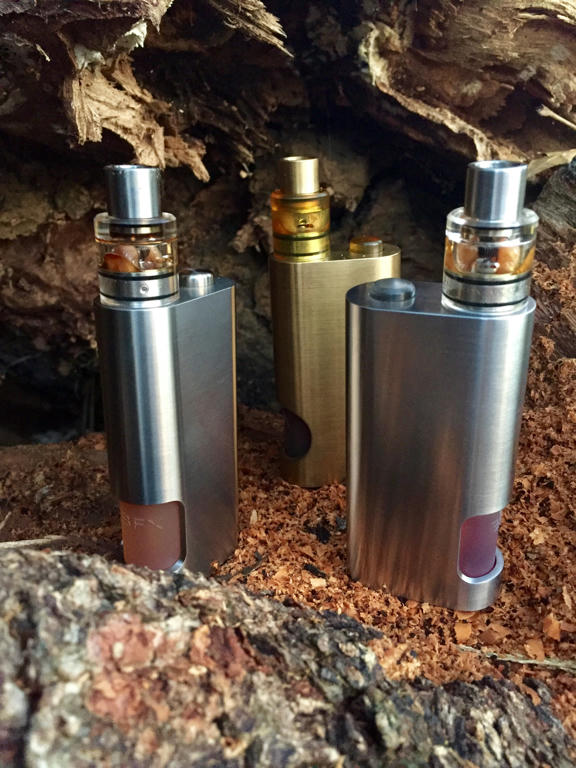

Drifter, those are fine pitchers. Your attention to detail is amazing. Your clear caps are perfect, & drip tips match beautifully. Wish I had the equipment to do such work.
I'll just have to admire your talent.




Awesome !!!

Drifter, those are fine pitchers. Your attention to detail is amazing. Your clear caps are perfect, & drip tips match beautifully. Wish I had the equipment to do such work.
I'll just have to admire your talent.
Thank you very much Boobsley
 Your post just made my day

I learned a lesson about magnets last weekend. I went bushwalking and was trying to gauge my location by determining which direction the creek was running. I couldn't understand why my compass said the sun was setting in the north. I know some things are different down here, but the sun still sets in the west!
Anyway, I sat down on a rock for a vape and suddenly the compass was pointing in the right direction. It took me a few seconds to realise what had happened.
Soooooooo ... when using a compass, don't have your CC too close

We have magnets!

Thank you very much Boobsley
See? Even the new members see the same qualities in you

Drifting by to drop some pics
Those are just amazing!! The pics...the caps...the mods...take your pick


Drifting by to drop some pics
Nice flicks Mr. Drifter! ( and those top caps of yours are simply ba'dass.
)
SHhhh .. don't tell Corey,Drifting by to drop some pics
...but the atties caught my eye first Fantastic looks
Just beautiful!Drifting by to drop some pics

Are these compatible with the older mods like my brass?Indeed!!!
A bit of housekeeping.......
I'll be slowly integrating the new mods into the mix. My plan to go balls to the wall, right off the bat was a tad over zealous, I'm afraid...
Too many little things to work out along the way, for the first few anyhow... Right now, I'm waiting on s'more bridge/insulator/figure 8 lookin' thingies. They just need to be 3D printed locally, so no serious wait time or anything. A few days pro'ly...
Also, I have switched to the Veritube BF 510's for the new mods. Thanks to @Drunk_J and Gdeal and a few others for helping to design the things, and thanks to @turbocad6 for reassuring me that they are awesome, and do not leak, at all.
The ability to purchase as many, or as few as I need, without having to worry about lead times and such, is a nice bonus. Also, they are less costly, so no additional 510 upgrade charge will apply. I really hated having to do that, btw...
While I really like the other 510, this one makes more sense for me, atm...
These new ones do have a PEEK insulator, which is nice... They also come with a variety of little o-ring to seal things up, nice and tight...
See the little red o-ring, just under the head of the pin...

Very nice.
Also, you can put another o-ring that comes with it, on the peek insulator to seal off the outer threads, as well. Like this....
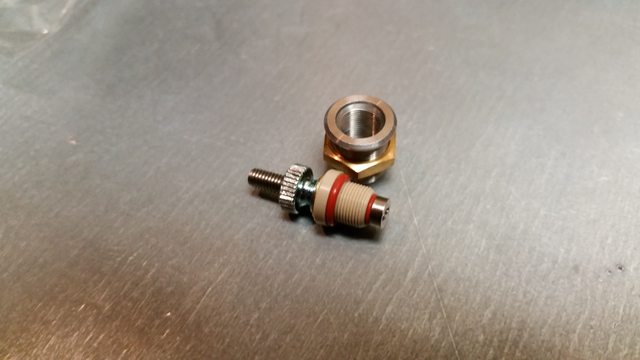

Cannot leak, whatsoever...
I originally had high hopes to be able to use the spring loaded feature on these, but these mechanical mods, the way they are designed, will not allow it.
Picture this..... the contact would be sandwiched between two nuts, riding on the pin, there. As you screw the atty in, the pin would be forced down, and right along with it, the positive contact. These mods need for the positive contact to be in a fixed position, up and down. If it is allowed to travel downwards with the pin, it is moving closer and closer to the top of the battery. Run it in enough, and it will auto fire... not to mention that it will be taking the tension off the underside of the button. No bueno...
Also, the contact would be allowed to swing side to side when you tighten and loosen atties. It really does need to be fixed tight in there so this can't happen.
I have given this a lot of thought, and am of the opinion that all adjustments to pin height, should be made with the pin either going up or down. I want that insulator to remain all the way up in that housing, good and tight. This keeps any leakage from happening around the outside of the insulator. With the o-ring around the insulator, this drops the pin height to where any adjustment will only be necessary if your atty doesn't reach the pin to make good contact. You'll simply run the pin up a little, to a good height to make contact. The o-rings allow for a good amount adjustment, and still create a good seal in there.
There is still a good recess in the cap for an o-ring to sit under your atty, if you are like me and like to use an o-ring under there.

I'll include both a thumb nut, and a small hex nut, so you can choose which one you want to use. Given that you need to swing the contact out of the way to remove the button for cleaning, I think it's nice not to have to break out the tools.

Side note: You wouldn't believe how hard it is to find a thumb nut that's M3.5 x .6 thread pitch...
The ones I'm using now are plated brass. They are M3, so I have to drill them out, and tap them to the required threading. Plus side is, they are a little smaller than the ones I've been using, so we got that going for us... :
Man, that's a lot o' words.... sorry 'bout that...
Back to work now....

Sent from my SM-N910V using Tapatalk
Wow, look at how much has changed, that I can call my brassy an "older version" [emoji38]
Sent from my SM-N910V using Tapatalk
Sent from my SM-N910V using Tapatalk
See? Even the new members see the same qualities in you
Those are just amazing!! The pics...the caps...the mods...take your pick
SHhhh .. don't tell Corey,
Fantastic looks
Just beautiful!
Thank you my friends
I really appreciate the kind words Are these compatible with the older mods like my brass?
Sent from my SM-N910V using Tapatalk
No, sir. These have a different thread pitch on the outside of the housing, where it threads into the cap.

Izzat mean mine has to be sent in for retrofitting?No, sir. These have a different thread pitch on the outside of the housing, where it threads into the cap.
Tapatyped
For all classic models, I still highly recommend Peter's 510. They are a perfect drop in fit. The only problem is, I'm going to run out of them in the near future, so you may have to buy direct from him.
I just had to make a decision on the 510 for all 3 of the new style mods, some time ago, and decided to go with the other one.
All Classic mods in the wild, and the 30 or so on the shelf, are threaded for the Peter 510, or the FDV Classic 510.
That's not to say I can't drill out an old cap and put the Varitube 510 in there. I can, only there will be no thread engagement between the SS 510 housing and the cap of the mod. We'd be relying solely on the big brass hex nut to hold the 510 in place. Of course, there are plenty of mods out there that are done just like that, with just a thru hole in the top, and the 510 held in place with a nut underneath... It would most likely be just fine, though I do like the idea of it being threaded into the cap.
I just had to make a decision on the 510 for all 3 of the new style mods, some time ago, and decided to go with the other one.
All Classic mods in the wild, and the 30 or so on the shelf, are threaded for the Peter 510, or the FDV Classic 510.
That's not to say I can't drill out an old cap and put the Varitube 510 in there. I can, only there will be no thread engagement between the SS 510 housing and the cap of the mod. We'd be relying solely on the big brass hex nut to hold the 510 in place. Of course, there are plenty of mods out there that are done just like that, with just a thru hole in the top, and the 510 held in place with a nut underneath... It would most likely be just fine, though I do like the idea of it being threaded into the cap.
- Status
- Not open for further replies.
Similar threads

- Replies
- 0
- Views
- 1K

- Replies
- 2
- Views
- 1K
- Replies
- 0
- Views
- 1K
- Replies
- 2
- Views
- 2K
Users who are viewing this thread
Total: 10 (members: 0, guests: 10)