

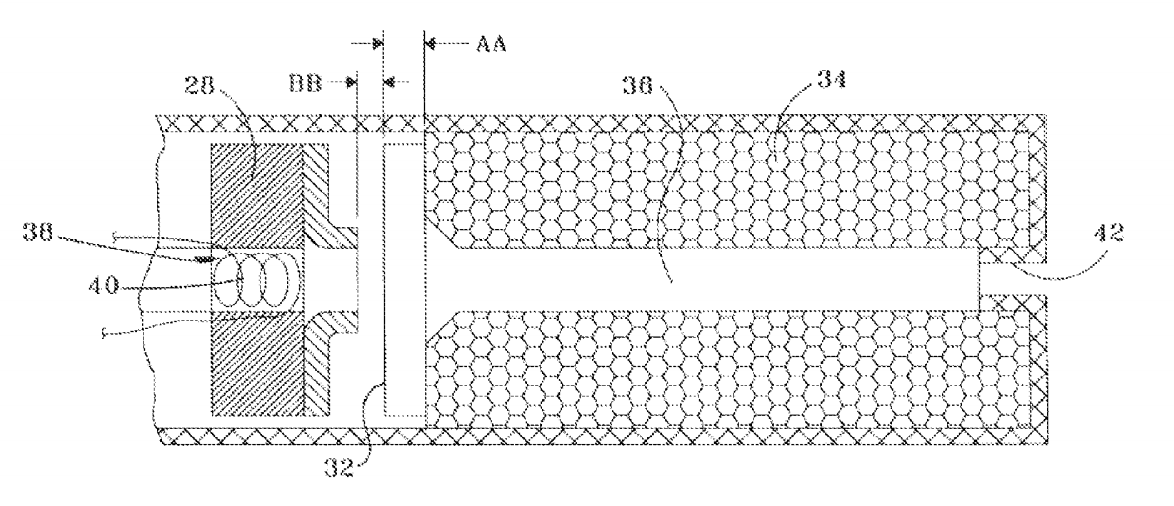
Below is shown an invention claimed by Lik Hon in U.S. Pat. Pub. No. 2015/0034103. Unlike most e-cigs, where the wick is in contact with the coil, he presents a different approach. When a user inhales at the nozzle (42), air is drawn through a heating coil (40). The air is heated (e.g., to 500 F) and then proceeds through a thin mesh element (32) containing e-liquid. The hot air vaporizes the e-liquid, which then travels down the outlet (36) and out the nozzle. The e-liquid to feed the mesh is located in chamber (34), which helps to cool the vapor.
Claimed advantages by the inventor of this approach:
- Liquid does not come into contact with the coil, which avoids the loss of heating efficiency resulting from deposits and liquid residue collecting on the heater coil.
- Longer coil life, due to lower thermal shock to heater coil and less corrosion.
- May reduce chemical changes in the liquid as it is only heated by air.
- Heater coil can be played with corrosion resistant materials to prolong coil life, such as silver or nickel-chromium, which degrade when in contact with an e-liquid.
- Since the coil heats air, not e-liquid, it can achieve faster vaporization.
So what do you think? Is a better or worse design than the current approach?
My biggest doubt is whether heated air alone can provide enough heat energy to achieve sufficient vaporization. Maybe if the mesh element pre-heated the e-liquid just below vaporization, this approach might work better than the current method.
Claimed advantages by the inventor of this approach:
- Liquid does not come into contact with the coil, which avoids the loss of heating efficiency resulting from deposits and liquid residue collecting on the heater coil.
- Longer coil life, due to lower thermal shock to heater coil and less corrosion.
- May reduce chemical changes in the liquid as it is only heated by air.
- Heater coil can be played with corrosion resistant materials to prolong coil life, such as silver or nickel-chromium, which degrade when in contact with an e-liquid.
- Since the coil heats air, not e-liquid, it can achieve faster vaporization.
So what do you think? Is a better or worse design than the current approach?
My biggest doubt is whether heated air alone can provide enough heat energy to achieve sufficient vaporization. Maybe if the mesh element pre-heated the e-liquid just below vaporization, this approach might work better than the current method.


