
I have searched a ton, read a ton, but still am left a little confused. I see all of these pictures of RBA's with coils/wicks and screws popping out. I understand that you essentially make your own coil, add some wick, and drip into the atomizer (tube just covers all that mechanical stuff, right?) But I'm confused on how the "tanks" work. I would really like to try a RSST or Kayfun but have no idea whats going on. Is it a tank like a evod, only with a more advanced juice feeding system? Is that how all of these tank looking RBA's are? I'm looking to get into it but dont know where to start.
You are using an out of date browser. It may not display this or other websites correctly.
You should upgrade or use an alternative browser.
You should upgrade or use an alternative browser.
Someone please explain RBA/tanks ?
- Thread starter skakid812
- Start date
- th_trl_thread_readers 0
- Status
- Not open for further replies.

I think checking out Grimm's recent upload The AC9 and The RSST would be the best thing you could do to get a sense of the popular Genesis-style RBAs. Also, pretty sure the Kayfun isn't a Genesis, but it is certainly a rebuildable tank system.
If you're not familiar with wrapping your own coils, preparing and installing wicks, I highly recommend you start out with a cheap RDA of some kind to get a start out before you jump straight into RBAs, which have a moderate learning curve, or at least do your homework for exactly what you need to do to build/maintain your vape on specific device.
Igo-L $13.95
If you're not familiar with wrapping your own coils, preparing and installing wicks, I highly recommend you start out with a cheap RDA of some kind to get a start out before you jump straight into RBAs, which have a moderate learning curve, or at least do your homework for exactly what you need to do to build/maintain your vape on specific device.
Igo-L $13.95
I think checking out Grimm's recent upload The AC9 and The RSST would be the best thing you could do to get a sense of the popular Genesis-style RBAs. Also, pretty sure the Kayfun isn't a Genesis, but it is certainly a rebuildable tank system.
If you're not familiar with wrapping your own coils, preparing and installing wicks, I highly recommend you start out with a cheap RDA of some kind to get a start out before you jump straight into RBAs, which have a moderate learning curve.
Igo-L $13.95
I'm confused on the difference. One of them you are literally just dripping a few drops at a time, and the other is a tank? I'm picturing it as being a fancy pro tank type deal where its gravity fed and just has better coils? I'll read that though.

Also, try posting your question in the RBA forum. Lots of helpful folks over there too.
Rebuildable Atomizer Systems
Rebuildable Atomizer Systems

RBA=Re-Buildable Atomizer. Example Kayfun Lite Plus, RSST
These are devices that contain e-liquid in a tank that is wicked to the atomizer which is rebuilt.
RDA=Re-Buildable Dripping Atomizer. Example IGO series, 510 RDA, Octopus
These devices have rebuilt coils, but require liquid to be dripped onto them directly for vaping (I think this is what you described)
Tanks=J Tanks, IB Tanked
These are tanks that require a cartomizer to be installed into the tank that is replaceable.
For all of the above there are numerous threads throughout ECF. Maybe this will get you started down the right road. Tanks are the easiest of them to get into, but the only one of the three I don't do any more.
These are devices that contain e-liquid in a tank that is wicked to the atomizer which is rebuilt.
RDA=Re-Buildable Dripping Atomizer. Example IGO series, 510 RDA, Octopus
These devices have rebuilt coils, but require liquid to be dripped onto them directly for vaping (I think this is what you described)
Tanks=J Tanks, IB Tanked
These are tanks that require a cartomizer to be installed into the tank that is replaceable.
For all of the above there are numerous threads throughout ECF. Maybe this will get you started down the right road. Tanks are the easiest of them to get into, but the only one of the three I don't do any more.
RBA=Re-Buildable Atomizer. Example Kayfun Lite Plus, RSST
These are devices that contain e-liquid in a tank that is wicked to the atomizer which is rebuilt.
RDA=Re-Buildable Dripping Atomizer. Example IGO series, 510 RDA, Octopus
These devices have rebuilt coils, but require liquid to be dripped onto them directly for vaping (I think this is what you described)
Tanks=J Tanks, IB Tanked
These are tanks that require a cartomizer to be installed into the tank that is replaceable.
For all of the above there are numerous threads throughout ECF. Maybe this will get you started down the right road. Tanks are the easiest of them to get into, but the only one of the three I don't do any more.
Thats what I'm curious about though, I get the tank setup with cartos but I mean the RBA's. Is it literally a tank that holds a certain amount of liquid that is fed to the coils that you build? I just cant picture it because I just see it flooding.
Your wicking material keeps it from flooding

It's certainly not unreasonable to think of the Kayfuns as being like EVODs / Protanks on steroids.
You suck through a tube with a coil in, and liquid is drawn into the tube through the wick. Because the liquid reservoir is airtight, it doesn't flow in until you suck (well... usually. No system is yet perfect)
Kayfun Lite - User Manual (English)
I second the Igo-L as a suggestion for a first rebuildable. There are so few variables to think about it's easy to nail the basics. If you use if for a month to learn on, then throw it away, you'd still probably end up financially better off than using disposables...
You suck through a tube with a coil in, and liquid is drawn into the tube through the wick. Because the liquid reservoir is airtight, it doesn't flow in until you suck (well... usually. No system is yet perfect)
Kayfun Lite - User Manual (English)
I second the Igo-L as a suggestion for a first rebuildable. There are so few variables to think about it's easy to nail the basics. If you use if for a month to learn on, then throw it away, you'd still probably end up financially better off than using disposables...
Thats what I'm curious about though, I get the tank setup with cartos but I mean the RBA's. Is it literally a tank that holds a certain amount of liquid that is fed to the coils that you build? I just cant picture it because I just see it flooding.
If you watch the video, you'll see that RBAs (RSST, aka "Gennys" etc) work against gravity by having vertical wicks and vertical coils. Your wick dips into the reservoir beneath and feed the coil juice by pulling it up. It's exactly the opposite of BCCs like the Protank and do not require replacement parts aside from wire/wick.
The RSST is a great starter RBA. It holds the liquid below the atomizer, and the wick goes into the tank. Here is a picture of one of mine set up.

This wick is made of mesh and is wrapped with 30 gauge kanthal wire. It is the easiest wick set up for beginners. The RSST has insulators on the wick hole, and a plastic tank which will keep the wick from shorting out the coil.
This wick is made of mesh and is wrapped with 30 gauge kanthal wire. It is the easiest wick set up for beginners. The RSST has insulators on the wick hole, and a plastic tank which will keep the wick from shorting out the coil.
I have an IGO-T, and it is my favorite dripper. It is much like the IGO-L
It tastes almost as good as my Kayfun, cost 1/4 the price, and is extremely easy to use. I love drippers cause you can have just a taste of the juice, without the commitment to a whole tank full!
EDIT: By the way, with a cotton wick, I routinely put about twelve drops of liquid in my IGO-T, and it handles it like a champ. I assume the IGO-L has a similar capacity...
It tastes almost as good as my Kayfun, cost 1/4 the price, and is extremely easy to use. I love drippers cause you can have just a taste of the juice, without the commitment to a whole tank full!
EDIT: By the way, with a cotton wick, I routinely put about twelve drops of liquid in my IGO-T, and it handles it like a champ. I assume the IGO-L has a similar capacity...
Last edited:

Genesis-style RBA tanks will leak if not kept in an upright position, therefore they are not the greatest out-&-about juice attachment. The wicking process is aided by tilting the mod up to assist the wick draw e-liquid to the coil (the "Genesis tilt").
RBA/RDA's are more complex juice attachments than factory-made clearotanks or cartotanks. Not only will you need to learn how to make wicks and wrap coils, you will need to own and use a digital multimeter to measure the coil's resistance that you make. They require a high quality "high drain" battery. You will need to know your battery's amp limit specifications, especially if you ever plan to do sub-ohm coils. You will need to learn how to use the Ohm's Law Calculator to insure the coil that you make will not pull more amps than your battery has to offer...this is critical. You MUST do your homework before attempting a rebuildable.
Make it a routine to always measure your coil's resistance on a regular basis. Do not assume that your 0.5 ohm coil will remain at 0.5 ohm during its term of use, coil resistance can change to a dangerous resistance especially if you do sub-ohms. For example; if you are using a 10 amp limit battery, a 0.5 ohm coil draws 8.4 amps from a battery (safe). A "small" drop down to 0.3 ohms will draw 14 amps from the battery (dangerous) - this can cause the battery to go into thermal runaway.
Cloud Chasing is Dangerous
Information Resources for Your First RBA
Battery Basics for Mods
Deeper Understanding of Mod Batteries
I will have to add that you must be willing to be a "tinker-er" if you use an RBA/RDA. They can be extremely fussy, especially in the beginning while you are learning the system. Always have a simpler backup system to use should your RBA go down the tubes.
RBA/RDA's are more complex juice attachments than factory-made clearotanks or cartotanks. Not only will you need to learn how to make wicks and wrap coils, you will need to own and use a digital multimeter to measure the coil's resistance that you make. They require a high quality "high drain" battery. You will need to know your battery's amp limit specifications, especially if you ever plan to do sub-ohm coils. You will need to learn how to use the Ohm's Law Calculator to insure the coil that you make will not pull more amps than your battery has to offer...this is critical. You MUST do your homework before attempting a rebuildable.
Make it a routine to always measure your coil's resistance on a regular basis. Do not assume that your 0.5 ohm coil will remain at 0.5 ohm during its term of use, coil resistance can change to a dangerous resistance especially if you do sub-ohms. For example; if you are using a 10 amp limit battery, a 0.5 ohm coil draws 8.4 amps from a battery (safe). A "small" drop down to 0.3 ohms will draw 14 amps from the battery (dangerous) - this can cause the battery to go into thermal runaway.
Cloud Chasing is Dangerous
Information Resources for Your First RBA
Battery Basics for Mods
Deeper Understanding of Mod Batteries
I will have to add that you must be willing to be a "tinker-er" if you use an RBA/RDA. They can be extremely fussy, especially in the beginning while you are learning the system. Always have a simpler backup system to use should your RBA go down the tubes.
Last edited:

I recommend starting out with a Genesis-style atty like the RSST and using 3/32 stainless cord as your wick and just wrap the area where the coil is going to be wrapped around with stainless mesh. This provides stability to the coil and allows you to wrap it a bit easier. Once you can get this method down, rolling a mesh or silica wick may prove to be a bit easier.
I use 4/3 wraps of 28g on all my builds, as it's my comfort zone for subohm stuff (I consistently get .7 to .8 ohm wraps) and I know that the batteries I have for this are safe. I wouldn't let this sort of thing intimidate you, as you eventually find your comfort zone and learn the warning signs.
I use 4/3 wraps of 28g on all my builds, as it's my comfort zone for subohm stuff (I consistently get .7 to .8 ohm wraps) and I know that the batteries I have for this are safe. I wouldn't let this sort of thing intimidate you, as you eventually find your comfort zone and learn the warning signs.
Opinions are obviously going to differ, but I'd say it's easier to start with any wick material that doesn't conduct electricity.
Silica is pretty hassle free. I think cotton is better, but it is a bit of a pain to get your head around the requirements at first.
I gravitated very quickly to SS mesh, then SS wire rope with mesh. But I'm certainly glad I made a few with silica first, just so I understood the basic techniques without having to pay anywhere near the same amount of attention to avoiding shorts.
Silica is pretty hassle free. I think cotton is better, but it is a bit of a pain to get your head around the requirements at first.
I gravitated very quickly to SS mesh, then SS wire rope with mesh. But I'm certainly glad I made a few with silica first, just so I understood the basic techniques without having to pay anywhere near the same amount of attention to avoiding shorts.

... EDIT: By the way said:That's exactly why I like my EGO-I. Next up will be a dual coil.
I have an IGO-T, and it is my favorite dripper. It is much like the IGO-L
It tastes almost as good as my Kayfun, cost 1/4 the price, and is extremely easy to use.
I'll second the IGO-T. I got mine last week and it's been used daily since then. Superb dripper, very lightweight, and has a heavy duty well. Stock airflow is very good too, nice medium draw. Also, it looks mega mondo sexy on my SID. It does however, not make a connection on the MVP v2.0.
Oh well :\

What keeps the conductive materials (stainless rope or mesh) from shorting out the coil?
Tears. Sometimes blood.

It's a combination of positioning and oxidation. A 'seasoned' wick and coil, which is to say well used ones, are much less likely to short - they have a layer of less conductive 'gunk' on the surface, presumably partly soot and semi-combusted juice, partly a layer of metal oxides.
But to begin with they will short very easily, and you simply have to keep firing and poking it until it stops. You only want the coil touching the wick in the barest possible way with stainless. In fact, it's seems from my limited experience that it might be optimal if the coil doesn't actually touch the wick at all, but is minutely above it the whole way round - you'll rarely, if ever, achieve that though.
You can accelerate the oxidation process using a blowtorch or lighter to make things easier (although I've read that there may be health concerns if you oxidise too much, and it definitely alters the taste).
It's a combination of positioning and oxidation. A 'seasoned' wick and coil, which is to say well used ones, are much less likely to short - they have a layer of less conductive 'gunk' on the surface, presumably partly soot and semi-combusted juice, partly a layer of metal oxides.
But to begin with they will short very easily, and you simply have to keep firing and poking it until it stops. You only want the coil touching the wick in the barest possible way with stainless. In fact, it's seems from my limited experience that it might be optimal if the coil doesn't actually touch the wick at all, but is minutely above it the whole way round - you'll rarely, if ever, achieve that though.
You can accelerate the oxidation process using a blowtorch or lighter to make things easier (although I've read that there may be health concerns if you oxidise too much, and it definitely alters the taste).

this is partly true, the wire will quit shorting once there is a positive layer of oxide or carbon under the coil. but a coil needs to be wrapped snug on the mesh or it doesnt vaporize efficiently and will cause hot spotting and uneven heating. once you get good at it you can even use just the coil to oxidize the wick, then as the wick builds up a "seasoning" shorts are pretty much done.
mesh wicks have the highest learning curve and failure rate for new rebuilders. and in some cases it is not for the faint of heart or those who can be easily frustrated. but the rewards of a properly setup mesh wick are outstanding vapor and flavor.
here is a completely unoxidized wick using just the coil to layer some carbon on it.
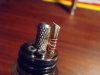
mesh wicks have the highest learning curve and failure rate for new rebuilders. and in some cases it is not for the faint of heart or those who can be easily frustrated. but the rewards of a properly setup mesh wick are outstanding vapor and flavor.
here is a completely unoxidized wick using just the coil to layer some carbon on it.
Last edited:

FWIW, my first RBA was an EHPRO Kayfun Lite clone. I used 32 awg Kanthal with organic cotton wicks. I had never wrapped a coil before. My first setup was 4.2 ohm, lol. I mistakenly thought thinner Kanthal had less resistance. After becoming un-stupid, I realized that I had that backwards. In any event, after my 2nd try, it's been smooth sailing. The Kayfun style RBA's are very easy to learn on IMO. I liked my KFL clone so much that I went out and bought a Russian 91. I also have two more clones on the way since buying the real deal is not easy in the states (and buying from the UK jacks the price up accordingly). Stupid exchange rate...
- Status
- Not open for further replies.
Similar threads

- Replies
- 2
- Views
- 645


- Replies
- 35
- Views
- 2K

- Replies
- 6
- Views
- 1K


- Locked
- Replies
- 21
- Views
- 22K


Users who are viewing this thread
Total: 2 (members: 0, guests: 2)