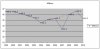
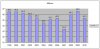
I think my comment about the slope is correct. It is still a slope that is greater than evidenced in prior years except for the dubious 2006 to 2007 period. Am not saying the 45.3 million number shown for 2010 is wrong - just that it may deserve closer scrutiny and thought as to accurateness. But maybe of no consequence anyway as your comments seem to suggest that FDA is doing the right things to effectively reduce the number of smokers. FDA denigrates e-cigs in mid-2009, number of smokers down by end of 2010. Kind of doubt that was the plan but seems to have been the result.
But, having been a long term smoker and knowing that what FDA (or the Surgeon General) might say about smoking was not going to change that practice, a reduced risk substitute had merit to it in my opinion. That alternative, for me, resulted in the giving up of the smoking. It may be that my eventual practice will be to give up e-cigs as well. But even if the e-cigs continue, e-cigs have provided a meaningful step toward eventual abstinence. I tend to believe it will be easier to part with the e-cigs than to part with the smokes. Would it have been the case that had there been no e-cigs that other methods would have been found to stop the smoking. Hard to say. Gum and patches have been around for a considerable period of time now and they did not entice me to stop. To me it seems reasonable and logical that e-cigs (and smokeless tobacco as well) be viewed as aides toward the reduction of smoking prevalence. But if it takes the FDA to denigrate them to cause the population to consider them - I'm for more denigration.
I'm going to take another stab at explaining this, since you understood me to say the opposite of what I was trying to convey.
No, I was not trying to say that the FDA trying to ban e-cigarettes made them popular.
Their press conference brought to the attention of
people who already used e-cigarettes that the FDA was, in effect, stealing from vendors by seizing incoming shipments that were already paid for. People
who had not heard of e-cigarettes prior to July 2009 were mostly frightened by the FDA's misleading press release. Local press coverage got some "man on the street" reaction with smokers saying such things as, "Man, I was going to give those things a try. But they got antifreeze! They'll give you cancer! I'm going to stick with my (much safer) Marlboros."
The sales of e-cigarettes picked up at the start of 2010, once it became more likely that the FDA was NOT going to be able to pull off banning the products, thanks to Judge Leon's ruling. As far as a slope goes, it went up from the end of 2004 to the end of 2009. At the start of 2010 it headed downward. We won't know whether this is an anomoly (like 2007) or a trend until there is another point to plot. If the prevalence rate continues to decline for another year or two, we will know that we have turned a corner.
And with more voices joining ours every day, it is going to become harder and harder for the antis to try to say, "there's no evidence they work" and "they could be more dangerous than smoking (regular cigarettes).
There is evidence they work. Perhaps that evidence doesn't add up to "proof" as yet, but proof is made up of more than once piece of evidence. In a court of law, for a civil case it is decided by a "Preponderance of the evidence". In a criminal trial, you need "Proof beyond a reasonable doubt."
The antis have nothing but manufacturered evidence as proof they are harmful. "We found antifreeze in them." So? Unless you drink 6,800 cartridges of e-liquid in a single day, you can't be poisoned by the trace quantity found. "We found carcinogens." So? A user would need to vape a thousand or so cartridges to match the amount of the same chemical taken in by a day's worth of smoking.
Frankly, I was way too far gone to be better off waiting for "proof beyond a reasonable doubt" or even a "preponderance of the evidence." I was already wheezing, just laying abed at night. The whistling noise was keeping me awake. I was already coughing up a gob of yellow cloudy phlegm every morning. I did not have 10 years or more to wait for absolute proof. The evidence was good enough for me. My health got better, not worse.
And after dozens of failed attempts, I was finally a "former smoker." Good enough for me