Per Kat's request. Stashed here:
Not sure how to incorporate BR's info yet. May have to figure out how we'll break it all up 1st...
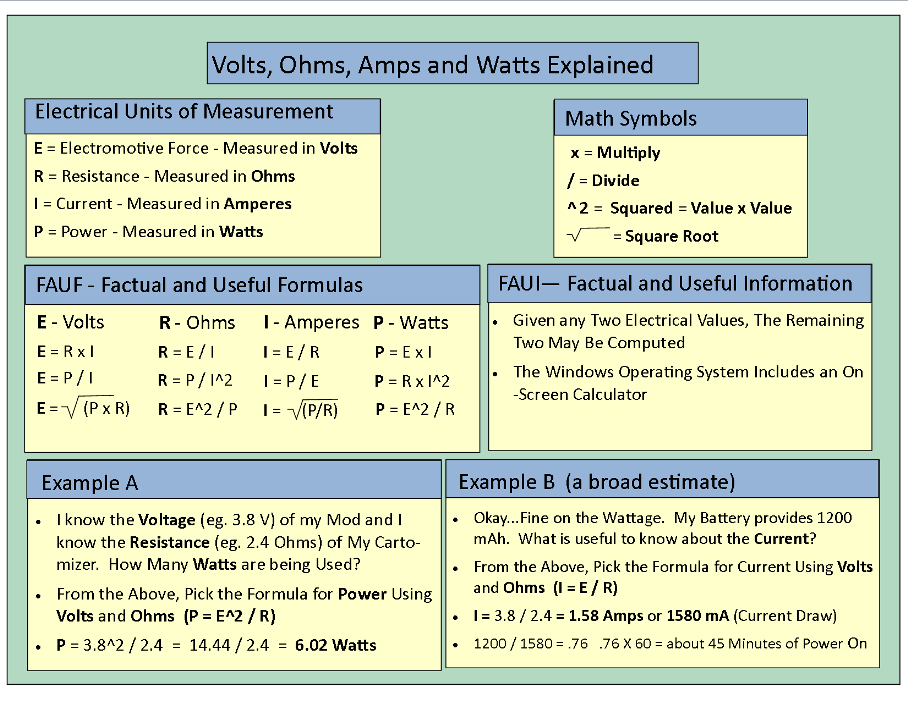
Asked Cool_Breeze if he would let us quote his chart:
http://www.e-cigarette-forum.com/fo...n/435997-volts-ohms-amps-watts-explained.html
It basically restates the formulas, but it does it nicely formatted. It uses the "other" set of variable names though ...E for voltage rather than V. E is probably more correct, but harder for people to relate to. It's a NICE chart with factoids.
Also bump.
Volts, Ohms, Watts, and Amps.
E-cigs introduce you to terms that you probably wouldn't use everyday without them. Yet, you need to understand some of them, in order to wade through the sites and options and understand the effect of your choices. This post discusses the electrical terms in particular; volts, ohms, watts and amps. The good news is...it isn't really that bad. The bad news is that it isn't a 2 second discussion.
The short answer is that if you have a Variable-Voltage (VV) or Variable Wattage (VW) device, you can just start low, dial it up, and make it work. No math required. Non-adjustable voltage PVs require you to select the proper ohm coil ahead of time.
However, if you want to UNDERSTAND how and why the ohms affect the heat, for example, that will take some work on your part. It's not too bad, but it's also something that you don't want to try to cram into a 2 minute reading. You may have to read this a couple of times. That's fine. Don't give up. If you really can't stand reading...skip to part 3.
Part 1 - coming to terms with it
OK let's get some terms straight first:
Volts = Electrical Pressure. Kind of like water pressure.
Ohms = Friction. Resistance to the flow of electricity. Without friction, we'd have no heat in our coils. Like a kink in a water hose.
Amps (amperes) = total electrons flowing past a point. Similar to the volume of water (# of molecules?) going past a point in the hose at one particular instant.
Watts = A measure of "work". Watts = Volts X Amps. How fast it could turn a water wheel.
Watts are kind of an "end-result". No work is done if there's no pressure. Also no work is done if there's no volume of water flowing. You have to have pressure and water flow to get an effective amount of water on the lawn from a sprinkler. High pressure with a very thin hose won't do it. Neither will no pressure with a fat fire-hose. You have to have volume and pressure at the same time. The constriction of a hose is a resistance (like ohms), and determines the flow rate for a given pressure.
All of these things are interrelated. If you change any one thing, the system as a whole is changed. In fact, if you know any two of the above variables, you can calculate the others. They are measurements for different aspects of a particular system. All pieces of the same puzzling phenomenon.
Volts, ohms, watts and amps are quantities that can be measured and related mathematically. That leads to the inevitable formulas....
Part 2 - Finally! Some math. Yay! (or OMG! I hate this stuff.)
Because volts, ohms, and amps are measurable quantities, someone took a lot of measurements of them and figured out how they all relate. The results of this relationship became "Ohm's Law" of electricity. The law was named after the German physicist Georg Ohm, who published them in the early 1800's. Thanks to James Prescott Joule there's also Joule's Law: Watts = Volts x Amps but we're getting ahead.
Now quantities measured need names for them. Feet, meters, pounds, grams are all units of measure. Some of the units of measure for electricity are defined above: Volts, ohms, watts, amps. We have abbreviations for them so we can use them in formulas. The bad news is that you'll see several versions of these abbreviations. The good news is that we'll try to tell you the common ones so you can substitute whatever version you like.
Abbreviations:
Volts =
V = E = (Straight line with little dots under it symbol for DC voltage)
Ohms =
R = Ω = Resistance
Amps =
I = A
Watts =
P = W = Power
It's very irritating when you see one set of formulas published here, and another set somewhere else that uses different letters or symbols. Your multi-meter (the tool used to measure these things) often uses a different set too. Yet we have to pick one set. No matter what we select, someone's not going to like it...depending on if they are a "purest" or of they are in the commonly-seen camp. We'll use V for volts, R for ohms (resistance), I for Amps (because A is used for something else except on multi-meters), and P for watts (Power).
OK, so this guy Ohm published a "law" that is stated in modern form as:
Amps = Volts ÷ Ohms or I = V ÷ R
Add in Joule's Law: Watts = Volts X Amps or P = VI
Mathematicians, having nothing better to do than math, re-arranged all this stuff and came up with a list of formulas

(note the X here means multiply...it's not a variable):
Amps (I) = V ÷ R, also I = P ÷ V and I = Square-Root of (P ÷ R)
Volts (V) = I X R, also V = P ÷ I and V = Square-Root of (P X R)
Ohms (R) = V ÷ I, also R = V2 ÷ P and R = P ÷ I2
Watts (P) = V X I, also P = R X I2 and P = V2 ÷ R
OK. So the formulas are listed above. What does all this have to do with e-cigs?
Part 3 - Getting to the point, now that we have background and formulas.
You, a user of e-cigs, are basically juggling multiple variables related to electricity. Sure, there's other stuff too...e-juice VG/PG ratios, wicking, etc. but we're discussing electricity here. The point is that there's no ONE variable...there's always multiple things going on at once. Selecting a PV has electrical concerns too...for example the "amp limit" of the device. Swapping a carto out with different ohms means that you'll adjust the voltage (for VV stuff) or deal with the results for fixed-voltage stuff. VW adjusts voltage for you...like it or not.
To reiterate,
you can't change one thing without it affecting the others somehow. So here's where we try to explain how what you do effects things. Also, note that this is not an e-cig safety thread. So we try to explain some things, but safety is another subject unto itself. Don't take this as gospel. We're trying to teach general concepts here.
One last point before we discuss each category. There's variables beyond Ohm's Law. Coil wire varies in material and diameter. Thermodynamics are very much a part of all this. And, as one of our resident sages says:
Some of that stuff is still back there in my noggin, but I don't make much use of formulas and whatever. For instance, Ohms Law is always a factor with any electronic design, but it just gets you in the ballpark. Other factors always exist and something has to be tweaked to get things up to spec. The final design in my case is usually trial and error.
Just make sure your "error" while running a "trial" isn't a dead short. Check 1st. br isn't saying "Be stupid and try anything". He's saying "Be smart and try stuff and tweak it."
Voltage...the Oomph factor
You have one of three types of PV's
1) Fixed voltage. They are "regulated" to a speific set voltage. They may dwindle below it before cutting out, but they are still "fixed" in that you can't adjust them. They are regulated though....electronic circuits inside attempt to make the voltage the same regardless of the battery charge. Some only do this when the battery is above the set voltage limit.
2) Variable voltage. Adjustable voltage (also adjustable wattage) e-cigs have circuitry to bump-up (boost) or regulate down (buck) battery voltage according to a dial that you set. Variable Wattage (VW) e-cigs read the resistance of the coil you've screwed onto the connector and calculate the voltage you need to acheive a desired wattage setting. So they adjust the voltage for you.
3) Follows battery voltage - ie two wires, a battery, and a connector. Vaping directly off the battery at whatever voltage it has at the moment. Typical for all-mechanical mods. Li-Ion (and that class of batteries including IMR) have a top voltage of about 4.2 volts but they drop quickly to about 3.7/3.6 volts and stay in that rage for most of the usable charge and then drop quickly below that to cut-off voltage.
Each of these types come in either swappable battery configurations (where you have a "cell" that you can remove) or internal battery configurations where you charge the whole unit somehow and cannot remove the battery from the electronics/mechanics.
How do you make a fixed voltage e-cig hotter or cooler? By selecting the proper ohm coil. It's the only "variable" that you can change. The voltage is fixed. And as we've learned above, if any two factors are known, all factors are set. So the heat will be P = V
2 ÷ R (or Watts = Voltage squared divided by coil ohms) for a single coil. So if you want to vape at 8 watts, and you know the voltage of your fix-volt e-cig...use R = V
2 ÷ P (voltage squared divided 8). A 3.7 volt e-cig needs 3.7 x 3.7 / 8 = 1.71125 ohms to get 8 watts. Of course, there's wiggle room. And in fact coil ohms vary a bit due to manufacturing variability. 2.0 ohms will work. 3.0 ohms is not that good. 1.5 ohms may even be a bit hot. On the other hand, some e-cigs are 3.4 volts (like the original authentic eGo) and they may do better at 1.5 ohms.
How do you make a VV, or VW e-cig hotter or cooler....by adjust the dial, of course! The difference is that with VW, it will "sense" the ohms of the coil that you have screwed on and calculate the proper voltage...assuming you don't fake it out with the dual-coil thing. More on DC (dual coil) stuff later. Due to differences in devices and coils, you may have to adjust VW a bit anyway. But it gets you into the ballpark regardless of what ohm coil you screw on.
So for regulated fixed voltage stuff, or for follow-battery-voltage stuff, you must select the proper ohms ahead of time...there's no adjustment for the voltage/wattage on the e-cig. Get it wrong, and it's too hot or too cool. It's not super picky though...there's a workable range of ohms within reason.
Wattage
You know wattage. It's like incandescent light-bulbs. More wattage = more energy used = hotter/brighter. It's the result of the voltage and the coil ohms per the formula above. Watts = heat for our purposes. Normal ranges are about 7-9 watts per coil. This is for "normal" coils. There are dual coils ...where the PV must supply double the current (amps) in order to keep the voltage high enough for two coils. Think of it like a two lane toll booth on a toll road allowing double the cars through at once. Electrons per second past a point = amps (current). So more amps are required for dual coils at any given voltage.
The watts for dual coils are, not surprisingly, doubled for the device as a whole. If each coil is 8 watts, you need to supply a dual coil with 16 watts total. This is why dual-coil users often run up against amp limits on their devices. The device exceeds it's expected amp draw and either signals a "short" or drops the voltage to compensate for lack of amps. It won't work as expected, if at all, unless your PV can supply the amps at whatever voltage you set.
For VW devices...just set the wattage. For VV only devices...calculate the voltage or just start low and adjust higher as needed. To calculate the voltage:
So for single coils: Try 7-9 watts as a ballpark/average. Let's say 8. So voltage = Square-Root of (P X R) = Square-Root of (8 X ohms)
For dual coils: double the ohms 1st. A 1.5 ohm dual coil is really two 3.0 ohm coils side-by-side on the same connector. So the voltage is calculated for 3.0 ohms, NOT the 1.5 ohms. So around 5 volts should be good for a 1.5 ohm DC at 8 watts per coil. Because the square root of 24 (3 ohms times 8 watts) is about 5 (OK....4.898979485566356
)
Milliamp Hours (mAh)
You get billed on your electric bill by Kilowatt hours. That's the # of (thousands of) watts used for an hour. Note that there's an amount and a duration. A 2000 watt heater run for exactly one hour is 2 KWh. In the USA that's about 22 cents worth of energy, depending on location. So what is a Milliamp hour? Well, a milli-amp is 1000th of an amp. Thus 1/1000th of an amp run for 1 hour. An e-cig battery rated at 650 mAh can run 650/1000ths of an amp for an hour (well, not exactly, but electronics are usually using very small loads so that's how they are rated...in mAh).
However, that heater is dang cheap when you consider how hard it is to stuff that much energy into an e-cig battery. That would be a 1,000,000 mAh battery. See? lol. It's hard to stuff electrons into a battery. And we never have enough capacity.
So mAh is a capacity measurement. Like the size of a gas tank. Or the amount of water in a full water tower. I suppose you could give them a # of electrons difference between poles rating, but it's a crazy big number. Just remember that mAh is a capacity estimate....it gives you a rough idea of how much energy is stored in the battery for use over time.
Just like you can't predict how far an arbitrary car will drive by knowing the size of the tank alone (you'd also need to know the engine's MPG and the weight, and the amount of idling...etc) you can't predict how long a battery can be used without knowing the "load" on the battery. There is a common "rough guess" figure floating around here that every 100 mAh of battery capacity = approximately 1 hour of average vaping time. Even that varies quite a bit, because device designs, coils, and personal vaping usage vary quite a bit. And so do the mAh rating accuracies of the batteries. Some manufacturers seem to be more...accurate...than others. Ahem.
However, it still gives you a rough idea of the capacity of a battery when compared to another similar device used with the same coil by the same person.
Note that the safer chemistry of the IMR batteries has a trade-off in slightly lower storage capacity as compared to Li-Ion. However there are "hybrids" that use other chemistry that's somewhere in between. And ...it's an art and a science...even designing these things. There are new developments on the horizon all the time. So keep up to date and double check current information as this post becomes more out of date.
amp limits
SLR
Symbols on multimeters
What about:
mAh?
Series vs Parallel (or covered under DCC)
Battery stuff (Like IMR vs protected?)
Battery University:
http://batteryuniversity.com/
Handy Charts:
vaping wattage chart needed (baditude posts one all the time)


 that's one way to fight back!


