Keeping viscosity in mind?

Status
Not open for further replies.

scutterflux

Full Member
Verified Member
Aug 4, 2014
53
28
Canada
Just thought I'd share a little calculating I've been doing. Could be useful for some.

VG is thick we use PG, water and Alcohol to thin it, but how much of each to keep a consistent viscosity between blends?

I've come up with a simple ratio to use when thinning VG.

10% PG is roughly equal to 4% water and or alcohol. (alcohol is actually more viscous than water but the difference is somewhat negligible)

So if you know you like a 50/50 blend but want to try water or alcohol, you could say for example:

Take 20% PG exchange it for 8% water/alcohol replace the rest with VG and you have the equivalent to a 50/50 mix.

62% VG
30%PG
8%

Or say you liked the viscosity of a 70/30 pg/vg blend but wanted to use only water/alcohol to thin but you use 5%PG base flavour, then:

take the remaining 65% PG you want to replace, multiply by .4 (viscosity ratio of water to PG) = 26% water/alcohol

so

69% VG
5% PG (flavour)
26% water/alcohol

Hope this is helpful for someone.
 

dannyv45

ECF DIY E-Liquid Guru
ECF Veteran
Verified Member
Apr 12, 2013
7,739
8,425
New Jersey
www.e-cigarette-forum.com
You can use the juice me up cal for that and that may work for your vaping hardware but may not work for other hardware. Viscosity is very hardware specific. A carto may require a thinner mix then a clearo and a clearo may require a thinner mix then an rba and depending on how you build an RBA may also be a factor as to what the viscosity should be. It's really trial and error and once you have it stay with it. Thinning is generally used to make a device wik properly and not ment as a replacement for fluid such as PG/VG.
 
Last edited:

Kurt

Quantum Vapyre
ECF Veteran
Sep 16, 2009
3,433
3,607
Philadelphia
Bare in mind also that the viscosity of the e-liquid in the tank will increase with time as you vape, as will the bp of the liquid. This is because the content of the vapor is NOT the same as the content of the liquid. More volatile compounds vaporize faster than less volatile compounds.

For example, suppose we make a simple binary mixture of 90% VG and 10% water, no flavor or nic or PG, just these two components, put it in a tank and vape it. The vapor content will be well over 90% water! The point is water will be vaporizing out faster than the VG, and thus the liquid remaining in the tank will over time have less and less water compared to the VG. VG is vaporizing too, but not as fast as the water is.

This is why when I fill my Kayfun with my VG-juices (VG, flavor, water, nic), after vaping a while I often have to squirt in a little water or else it will not wick as well. Of course that could also depend on my build, but the liquid seen through the clear tank over time is clearly thicker than when I started.

Also, I believe ethanol is less viscous than water. It also has a higher vapor pressure and lower bp than water. H-bonds less than water too. My experience is 5% ethanol will have about the same lowering of viscosity as 10% water. But then again, I'm not a fan of inhaling ethanol in any amount.
 

Alien Traveler

Vaping Master
ECF Veteran
Jul 3, 2014
4,402
5,789
United States
I am afraid things are much more complicated. It seems like usual considerations of boiling multicomponent liquid are not suited for overheated coil/wick/juice system. I believe (just believe) that slow liquid delivery to coils through wicks (as compared to submerged coil) and coil overheating lead to relatively consistent production of vapor of about the same composition as juice.
Anyway, I usually fill my 2.8 ml tank full (just small air bubble remains) and vape it practically empty with about .2-.3 ml left on bottom. I do not feel any changes in my vape, either tank is full or empty.
 

Double Helix

Senior Member
ECF Veteran
Verified Member
Jun 1, 2014
176
91
Houston, TX
Bare in mind also that the viscosity of the e-liquid in the tank will increase with time as you vape, as will the bp of the liquid. This is because the content of the vapor is NOT the same as the content of the liquid. More volatile compounds vaporize faster than less volatile compounds.

For example, suppose we make a simple binary mixture of 90% VG and 10% water, no flavor or nic or PG, just these two components, put it in a tank and vape it. The vapor content will be well over 90% water! The point is water will be vaporizing out faster than the VG, and thus the liquid remaining in the tank will over time have less and less water compared to the VG. VG is vaporizing too, but not as fast as the water is.

This is why when I fill my Kayfun with my VG-juices (VG, flavor, water, nic), after vaping a while I often have to squirt in a little water or else it will not wick as well. Of course that could also depend on my build, but the liquid seen through the clear tank over time is clearly thicker than when I started.

How would the water concentration of the solution decrease over time if VG is water soluble, and we're assuming that the solution is homogeneous? Considering the way that the kayfun wicks it shouldn't have much of an effect on the rest of the liquid in the tank. According to your theory a mixture of VG and PG would produce the safe effect wouldn't it?
 

Kurt

Quantum Vapyre
ECF Veteran
Sep 16, 2009
3,433
3,607
Philadelphia
I am afraid things are much more complicated. It seems like usual considerations of boiling multicomponent liquid are not suited for overheated coil/wick/juice system. I believe (just believe) that slow liquid delivery to coils through wicks (as compared to submerged coil) and coil overheating lead to relatively consistent production of vapor of about the same composition as juice.
Anyway, I usually fill my 2.8 ml tank full (just small air bubble remains) and vape it practically empty with about .2-.3 ml left on bottom. I do not feel any changes in my vape, either tank is full or empty.

I agree that it is much more complicated for a multi-component liquid. And you are correct, I gave the example of VG (bp 280 C) and water (bp 100 C), and ideally the heating is not from some immersed coil, it would be from something like a heating mantle heating the container (generally a flask). A 10% water in VG solution will have a bp of about 138C. A phase diagram of this miscible binary mixture can be used to predict the vapor composition, and it would be almost entirely water. But you are correct, an immersed coil may have different results.

Immersion of the coil could super heat some of the liquid near it, and this can make the vapor composition closer to that of the liquid, but I'm not sure how much closer. A tank/coil system that wicks thick liquids well will vape down to almost dryness, but this says nothing about the composition of the liquid over time. It just says it wicks thick liquid as well as thin liquid, and the power is always giving enough heat to boil the liquid. If I am using a tank, the last mL of liquid is always thicker than the original liquid, but then I don't use PG at all (other than what is in the flavor, less than a few % generally). My liquids are simply VG, water, flavor and nic. If you are using PG (180C), VG(280C) and nic (240C), then yes, the vapor will be closer to the liquid composition, since the bps are closer to each other.

But vaping to dryness, again, says nothing about the composition over time, liquid or vapor. It just says the system works well. The reality is probably somewhere between ideal phase diagram predictions and vapor composition = liquid composition. And of course every component added adds another dimension, literally, to the overall liquid-vapor phase diagram, and I've never seen anything beyond 3 components (3d diagram).

Lots of variables, and at this point no one has the definitive answers. We are currently studying temperatures and vapor compositions, including possible decomposition products, but I will save that for another thread.
 

dannyv45

ECF DIY E-Liquid Guru
ECF Veteran
Verified Member
Apr 12, 2013
7,739
8,425
New Jersey
www.e-cigarette-forum.com
Hi Dr. Kurt

Thank you for your participation in this discussion. It's always a pleasure to hear from you. I never miss your participation on VPLive and I recommend the particular segment you were in on DYI safety in my safety and supply blog. If anybody has not seen this I highly recommend you watch.

https://www.youtube.com/watch?v=sOBDm8tSUEU&app=desktop
 
Last edited:

scutterflux

Full Member
Verified Member
Aug 4, 2014
53
28
Canada
Nice discussion, yes, first you need to decide on what viscosity is needed for your atomizer that much is clear and once decided you can use the ratio of 10 to 4 PG to water/ethanol to maintain that while experimenting with your juice, that was the point. I did not know their was a ejuice calculator that did viscosity, neat I'll look that up.

The idea that having Water vs PG will somehow change the viscosity faster with what's left in the bottom of the tank could happen over time, but what you might also be witnessing is surface tension. The liquid might appear less viscous as it will have a higher surface to volume ratio as well as the greater affinity to the walls of the atomizer (a simple example would be like a raindrop on a window, it appears to be very viscous until another drop is added, breaking the surface tension it then runs down the window). You also have the wick creating resistance to diffusion, and depending on the atomizer used a bulk flow into the base of the wick which would keep the whole solution primarily flowing in one direction. If this is of concern then a more viscous solution will slow any diffusion effects. Personally I have not noticed this to be a problem, but YMMV.

Also, Yes when vaping the alcohol would atomize the fastest, then water, then PG, then VG would, and the result would be that the liquid with the highest boiling point will tend to congregate around the coils, that I suppose is why some juices gunk up the coils. However, the coils do heat up rather quickly and the temperature and quality of the vapor does not seem to stagger itself in steps as it goes through these boiling points, as far as I can tell, which leaves me to think their is enough energy flux there to vaporize the whole solution nearly instantly. Also we consider your first earlier point then after a few puffs there is more liquid with a higher BP near the coils and this would cause the coils to reach that critical temp faster without as much staggering. Again these steps will all happens in milliseconds so is it really a concern? By the time the thicker VG starts to vaporize the coils are so hot that everything is vaporizing as a whole solution and the whole solution in the wicks feeding the coils moves together as a solution, the whole solution is meant to move by means causing bulk flow in most atomizer designs (not drippers so much, although there is still some capillary action)

Also ethanol is more viscous than water, I surprised myself to read this, these are of course at the relatively normal temperatures of the tank:

Ethanol:
1.144 mPa·s at 20 °C
0.794 mPa·s at 40 °C
0.570 mPa·s at 60 °C

Water:
1.002 mPa·s at 20 °C
0.6531 mPa·s at 40 °C
0.4658 mPa·s at 60 °C
 
Last edited:

Kurt

Quantum Vapyre
ECF Veteran
Sep 16, 2009
3,433
3,607
Philadelphia
How would the water concentration of the solution decrease over time if VG is water soluble, and we're assuming that the solution is homogeneous? Considering the way that the kayfun wicks it shouldn't have much of an effect on the rest of the liquid in the tank. According to your theory a mixture of VG and PG would produce the safe effect wouldn't it?

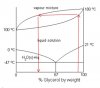
Precisely because water and VG are miscible, they form a binary homogeneous mixture, with their own phase diagram. Here is a PG-water diagram (The glycerol label is a mistake in that paper, it is for PG and water). BP of 100% PG is 180C. 0%PG (100% water) is 100C.

PG-Water_phase_diagram_90PG.JPG

The region to look at is the ovoid shape near the top. This is the liquid-vapor equilibrium region. To predict the composition of vapor from the liquid composition, start at the baseline at the desired % PG, go straight up to the lower of the two lines bordering the liquid-vapor region, then go straight to the left until you hit the upper line, then go straight down. Where the arrows end tells you the %PG in the vapor. With 90% PG (10% water), the vapor will be about 30% PG, 70% water.

A VG:water mixture will be even more enriched in water in the vapor, since the two BPs are even more separated, and the curvature of the liquid-vapor boundary is more box-like, less ovoid, like PG/water shown here.
 

Alien Traveler

Vaping Master
ECF Veteran
Jul 3, 2014
4,402
5,789
United States
I think a thread about process of juice evaporating should be started not here but at general vaping forum. For now I want to stress that "boiling liquid in a kettle" is very different from our case. For example, if it were like simple boiling than most of the flavors were forever trapped in a tank, not coming out with vapor (remember water distillation process?)
 

Kurt

Quantum Vapyre
ECF Veteran
Sep 16, 2009
3,433
3,607
Philadelphia
Also ethanol is more viscous than water, I surprised myself to read this, these are of course at the relatively normal temperatures of the tank:

Ethanol:
1.144 mPa·s at 20 °C
0.794 mPa·s at 40 °C
0.570 mPa·s at 60 °C

Water:
1.002 mPa·s at 20 °C
0.6531 mPa·s at 40 °C
0.4658 mPa·s at 60 °C

These are vapor pressures, not viscosities. generally viscosity increases with decreased vapor pressure. But maybe what we really are interested in is not the actual viscosity of ethanol vs water, but the effect of viscosity on an e-liquid. I have not done a lot with PG, but I have found ethanol has a stronger effect on the viscosity of VG liquids.

I do think there is something to the idea that liquids are superheated so can be close to everything boils. The diagram is for a controlled laboratory situation where the liquid is heated externally and very slowly, but I think the more volatile components will still vaporize faster than less volatile, because they are soluble with each other. The laws of thermodynamics require this to be so, at least under ideal lab conditions needed to create these diagrams. How close this is to vaping has yet to be determined. But we are working on it!

@Danny: Thanks, man! I also enjoy reading your wise and experienced posts!
 

Kurt

Quantum Vapyre
ECF Veteran
Sep 16, 2009
3,433
3,607
Philadelphia
I think a thread about process of juice evaporating should be started not here but at general vaping forum. For now I want to stress that "boiling liquid in a kettle" is very different from our case. For example, if it were like simple boiling than most of the flavors were forever trapped in a tank, not coming out with vapor (remember water distillation process?)

True to an extent, but many flavor compounds are quiet volatile. There is also the steam-distillation effect where even less volatile compounds will hop along for the ride. Distillation and vaporization is very complicated. Clove oil (eugenol) has a BP very high (254C), and is not miscible with water, but if I use water to extract and distill it, the heterogenous mixture will boil at about 100C, and the vapor will contain a good amount of eugenol (making the lab smell like cloves). I merely gave a simple two-component example of miscible liquids, boiled in an ideal way. I think you are correct that the heating system we use will deviate from that.

But this thread is about viscosity, and I think I have deviated from that more than a bit, although it is fascinating. My experience is viscosity increases in my tanked liquids as I vape, and I think much of that can be attributed to simple binary mixture vapor composition.
 

scutterflux

Full Member
Verified Member
Aug 4, 2014
53
28
Canada
These are vapor pressures, not viscosities. !

They're dynamic (absolute) viscosities.

"In the SI system the dynamic viscosity units are N s/m2, Pa.s or kg/m.s where

1 Pa.s = 1 N s/m2 = 1 kg/m.s
The dynamic viscosity is also often expressed in the metric CGS (centimeter-gram-second) system as g/cm.s, dyne.s/cm2 or poise (p) where

1 poise = 1 dyne s/cm2 = 1 g/cm.s = 1/10 Pa.s = 1/10 N.s/m2"

generally viscosity increases with decreased vapor pressure. !

That's what those numbers demonstrate and confirm. Vapor pressure goes up with temp viscosity goes down.

Vapour pressure units are; Pa, mmHg, Bars
 
Last edited:

Kurt

Quantum Vapyre
ECF Veteran
Sep 16, 2009
3,433
3,607
Philadelphia
They're dynamic (absolute) viscosities.

"In the SI system the dynamic viscosity units are N s/m2, Pa.s or kg/m.s where

1 Pa.s = 1 N s/m2 = 1 kg/m.s
The dynamic viscosity is also often expressed in the metric CGS (centimeter-gram-second) system as g/cm.s, dyne.s/cm2 or poise (p) where

1 poise = 1 dyne s/cm2 = 1 g/cm.s = 1/10 Pa.s = 1/10 N.s/m2"

Ok, I stand corrected! I saw units incorrectly and jumped way too quickly. I am more used to cPoise. Thanks for clarifying. But I do think it is the effect on viscosity, usually of VG, that is really important, with ethanol disrupting more H-bonds than water. I find it takes less ethanol than water to give similar viscosity to a VG liquid. Really opens up the flavors too...shame I can't use ethanol, dries me out too much, very much like PG does.
 
Last edited:

scutterflux

Full Member
Verified Member
Aug 4, 2014
53
28
Canada
Hi Dr. Kurt

Thank you for your participation in this discussion. It's always a pleasure to hear from you. I never miss your participation on VPLive and I recommend the particular segment you were in on DYI safety in my safety and supply blog. If anybody has not seen this I highly recommend you watch.

https://www.youtube.com/watch?v=sOBDm8tSUEU&app=desktop

Hi Dr. Kurt around 1:14:50 you begin talking about solutions.

You made a statment "about %5 alcohol to bring viscosity of VG juices to PG." at 1:16:57

But if I use a simple viscosity formula.

At 300K, (source:Dynamic Viscosity of some common Liquids)
Glycerine (vegetable): 0.95 Pa·s
Propalene Glycol: 0.042 Pa·s
Ethelene: 0.001095 Pa·s


In V = X1 * In V1 + X2 * In V2 = ln Vpg
V = v1*x1 + v2*(1- x1) = Vpg = 0.042
.95*x1 + .001095(1-x1)
x1 = (.042-.001095)/(.95 + .001095)= 0.043 which is x1, that is actually amount in VG% perhaps I'm mistaken, but I come up with 96% alcohol to 4% VG.

Now if we double check using a viscosity calculator (which I'd like to because I made a few assumptions to make the math easier) I used this: Mixing viscosities

VG like PG viscosity.jpg

So you can see the calculator shows 5%VG to 95% ethanol to equal the viscosity of PG.
 
Last edited:

scutterflux

Full Member
Verified Member
Aug 4, 2014
53
28
Canada
Ok, I stand corrected! I saw units incorrectly and jumped way too quickly. .
No problem, wouldn't be the first time I've done that either. Did you have a chance to look at my math using a simple viscosity estimation. I used percentages vs molar fraction and a few math assumptions but it seems to check out ok on that calculator???

But I do think it is the effect on viscosity, usually of VG, that is really important, with ethanol disrupting more H-bonds than water.

Interesting point, right because glycol is like an alcohol carbon chain it would likely make it less viscous due to less hydrogen bonding within the solution. I could see that, we need tools and testing equipment to figure this out for real.
 
Last edited:
Chenistry and thermo are a heck of a lot of fun, if you like convoluted puzzles, and throwing in some fluid mechanics makes it even more interesting. I do think one of the barriers to acceptance of vaping by the scientific/medical community is that so few people can actually understand it. Maybe no one does yet.

One of these days I will post or blog my answer to the perennial question, "No, really, how many drops are in a milliliter?" I intend to do it in terms that laypeople can actually understand (given a bit of effort, perhaps), so it is not a trivial endeavor. I hope you guys are around to pick it apart and improve it, when I finally have something worth posting (imagine images of pages flying off a calendar and mountains being worn down by rain).
 

Kurt

Quantum Vapyre
ECF Veteran
Sep 16, 2009
3,433
3,607
Philadelphia
Dr. Kurt!... I was re-reading the thread when I may have realized that it was you in the video. If so I want to make a public apology for the way I addressed you in an earlier post, I would have chosen different words had I sooner realized. I'll try to straighten out my posts to address you personally.

Cheers

Not a problem at all. I live in a peer reviewed world, and trust me I have been criticized far harsher than this.

I love being corrected, because I learn something new. Thanks for the detailed calculation, scutterflux! That figure 5% ethanol in VG was something I got from an e-liquid manufacturer, and was the general lore of DIY back when I did that interview, and I guess we never actually questioned it. Obviously we were wrong. I knew PG was much less viscous that VG, but about 1/25 is well below what I thought, but again, I never looked into it as rigorously as this. Clearly a 5% PG solution in ethanol would be unvapable, and not have much visible aerosol too. Would be quiet a buzz, however!

I really appreciate you so rigorously calculating viscosity like this. I definitely learned something here. Back when I was first doing DIY in 2009, and quickly figured out that PG caused all sorts of problems for me, we would "measure" relative viscosities by seeing how fast a few drops of a liquid would run down a tilted glass sheet or mirror. If they flowed the same rate, we assumed they were the same viscosity. Someone did this with ethanol and VG, and compared it to PG, and somewhere around 5% ethanol gave a similar flow rate to PG. All very imprecise and qualitative, and certainly not a viscometer, nor even how viscosity is actually measured, and does not take into account that those were flavored liquids too (more thinning), but that was the method in the DIY community. I never actually verified it! One, I didn't have an interest in using PG, and two, I didn't want to use ethanol any more.

My concern in DIY was how well my VG juices wicked and still vaped well. Flavors (mostly PG with often other small organics) tend to thin VG, and so does water, and I found that if %flavor + %water = ~22%, the juice would wick well for most of my attys. When I was using ethanol, it was %flavor + %ethanol = ~17%. Relating this to your excellent calculations, these juices were still much thicker than pure PG, but they were thin enough to work very well in my PVs. So what I should have said in that interview is that for unthinned flavored VG juices, about 5% ethanol (or about 10% water) if it is 10% flavor (standard) will allow it to vape well in the majority of attys, about like PG does.

The H-bond thing is rather complicated. They are the strongest intermolecular forces in pure PG, VG, ethanol, or water. In my mind, it is the ability of a substance to form long-range network interactions that determine its boiling point. Generally this also goes with viscosity, but clearly that is not the case with ethanol vs water, given this new information. But the H-bond influence does follow these two compounds in terms of bp. Water can give or take two H-bonds, so it is a balanced system, and long range networking is possible. Ethanol has an OH, so can give one H-bond, but takes two (two lone-pairs), so is not balanced...plus the ethyl tail that flaps around and disrupts interactions. So its bp is lower than water's. VG has 3 OHs, PG has 2, so neither are balanced, but more OHs make up for that compared to ethanol or water. Plus higher molecular weight means more London forces (weaker than H-bonds, but present). VG is also more polar than PG, and PG has a tail (CH3), so VG will form more H-bonds than PG, and more 3d networking.

But WHY water is less viscous than ethanol is a mystery to me. It has a higher surface tension, and higher bp and mp. Generally these go along with viscosity trends, but this one is baffling me.

Thanks again, scutterflux, for bringing some rigor to this discussion! I have learned much here! :)
 
Status
Not open for further replies.

Users who are viewing this thread