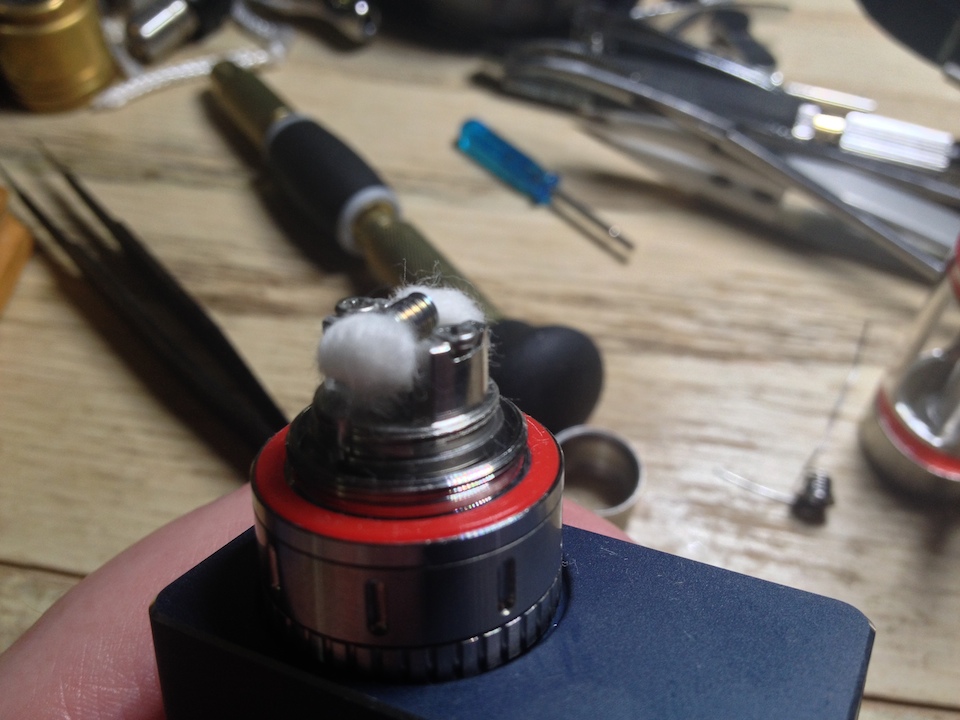
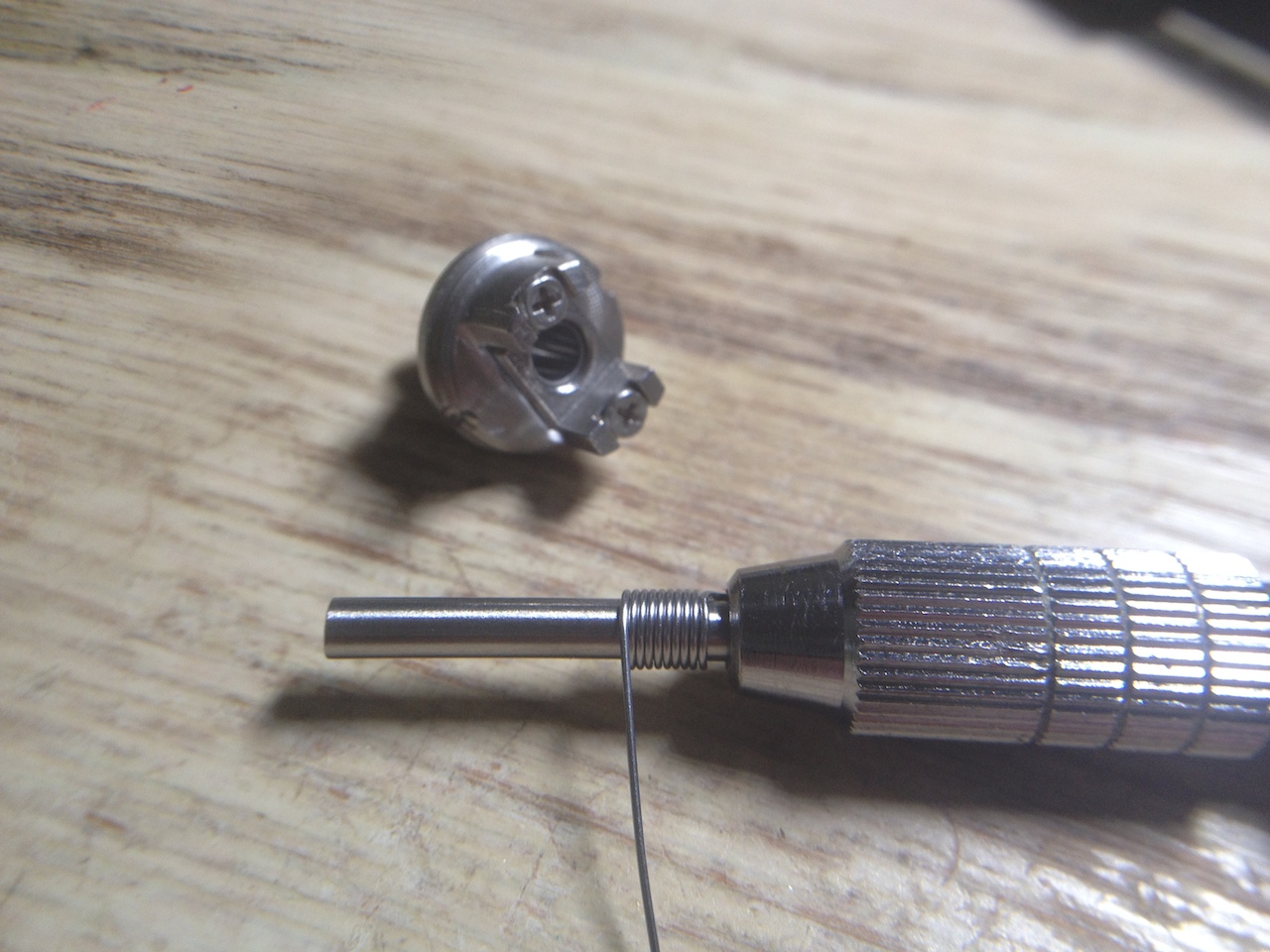
Even a good screwdriver with a 2.5-3.0mm shank will do ya to try it (perfect for most drippers). Tape or affix the wire to the handle and wrap. A needle nose plier or forceps for tension but I like to wind by touch. Put the shank right on the edge of the wire spool (3cm spool, no sewing bobbins for tension bro) and use the spool itself for leverage. The shortest distance from spool to mandrel. I've seen strong hands tension 24awg and it gets dicey fatter than 26 gauge but I'm almost 100% on winds down to 24-25 awg. Anyway, start just turning the wire with a light pull and gradually increase the strain with every turn. You'll see
and feel the point that the wire gets "sticky". That's when the turns are actually pulling in towards each other. As tight as nature permits. That's where you want to be. You've built solid rigidity into the wind without torching that
does not want to expand beyond the dimensions originally wound. Heaven.
And why do we want that? We'll there wire's surface is pristine. Nothing to impede a perfect oxidation of the wind in practical terms. Your chances don't get better. If you low voltage pulse from dark blood red teasing the coil into the medium red (red-orange)
you will see oxidation occur. A dim room helps. Try not to pour in too many volts or too fast as you will rapidly then lock the wire into the crystalline state that it's in
at that point. Too much heat (v/w) and you overcome the rigidity you just locked in before oxidation occurs. No t.m.c. If the softening of the wire exposed gaps that were present before oxidation (or mild compression with a ceramic tweezer) can close those minute spaces you won't have full-contact uniform oxidation we're trying to achieve…a complete circuit.
Pipe up if we can help.
There ya go lib. Best of luck to ya!