Tensioned Micro Coils. The next step.

Status
Not open for further replies.

super_X_drifter

ECF Guru
ECF Veteran
Verified Member
Oct 4, 2012
10,635
45,119
Somewhere out there
www.youtube.com
Mac, a lil time has past but lurking on the fringes of sanity :headbang:

Our man, the legend, @MattyB1503 says hello.

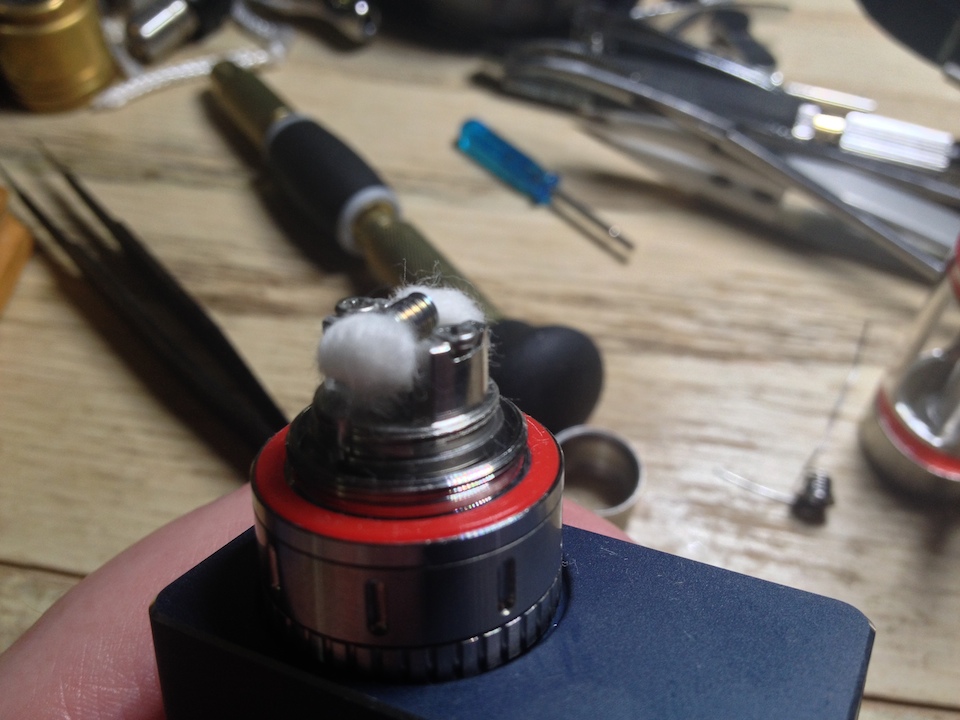
Here's some of my latest TMC action in one of his creations :

image.jpg


Now is that an atomizer or is that an atomizer? And are those some TMC's or are those some TMC's :lol:
 
  • Like
Reactions: SLIPPY_EEL

Libbydude

Super Member
ECF Veteran
Verified Member
Mar 14, 2012
604
1,080
Idaho
I finally tried tmc.
Got a coil master. Tried using it like the YouTubers. Didn't work for me so I tried something I'd read about somewhere.

Threaded the wire on and made a wrap. Clamped my bigass vice grips on and turned 6 wraps with the rod end.

Not a highly tensioned coil but got a few lbs into it. We'll see how it goes from here.

Edit: I got one too many wraps but overall it goes well so far. I may be sold.
 
Last edited:
  • Like
Reactions: MacTechVpr

MacTechVpr

Vaping Master
ECF Veteran
Verified Member
Aug 24, 2013
5,725
14,411
Hollywood (Beach), FL
I finally tried tmc.
Got a coil master. Tried using it like the YouTubers. Didn't work for me so I tried something I'd read about somewhere.

Threaded the wire on and made a wrap. Clamped my bigass vice grips on and turned 6 wraps with the rod end.

Not a highly tensioned coil but got a few lbs into it. We'll see how it goes from here.

Edit: I got one too many wraps but overall it goes well so far. I may be sold.

Even a good screwdriver with a 2.5-3.0mm shank will do ya to try it (perfect for most drippers). Tape or affix the wire to the handle and wrap. A needle nose plier or forceps for tension but I like to wind by touch. Put the shank right on the edge of the wire spool (3cm spool, no sewing bobbins for tension bro) and use the spool itself for leverage. The shortest distance from spool to mandrel. I've seen strong hands tension 24awg and it gets dicey fatter than 26 gauge but I'm almost 100% on winds down to 24-25 awg. Anyway, start just turning the wire with a light pull and gradually increase the strain with every turn. You'll see and feel the point that the wire gets "sticky". That's when the turns are actually pulling in towards each other. As tight as nature permits. That's where you want to be. You've built solid rigidity into the wind without torching that does not want to expand beyond the dimensions originally wound. Heaven.

And why do we want that? We'll then the wire's surface is pristine. Nothing to impede a perfect oxidation of the wind in practical terms. Your chances don't get better. If you low voltage pulse from dark blood red teasing the coil into the medium red (red-orange) you will see oxidation occur. A dim room helps. Try not to pour in too many volts or too fast as you will rapidly then lock the wire into the crystalline state that it's in at that point. Too much heat (v/w) and you overcome the rigidity you just locked in before oxidation occurs. No t.m.c. If the softening of the wire exposed gaps that were present before oxidation (or mild compression with a ceramic tweezer) can close those minute spaces you won't have full-contact uniform oxidation we're trying to achieve…a complete circuit.

Pipe up if we can help.

There ya go lib. Best of luck to ya!

:)
 
Last edited:

super_X_drifter

ECF Guru
ECF Veteran
Verified Member
Oct 4, 2012
10,635
45,119
Somewhere out there
www.youtube.com
Even a good screwdriver with a 2.5-3.0mm shank will do ya to try it (perfect for most drippers). Tape or affix the wire to the handle and wrap. A needle nose plier or forceps for tension but I like to wind by touch. Put the shank right on the edge of the wire spool (3cm spool, no sewing bobbins for tension bro) and use the spool itself for leverage. The shortest distance from spool to mandrel. I've seen strong hands tension 24awg and it gets dicey fatter than 26 gauge but I'm almost 100% on winds down to 24-25 awg. Anyway, start just turning the wire with a light pull and gradually increase the strain with every turn. You'll see and feel the point that the wire gets "sticky". That's when the turns are actually pulling in towards each other. As tight as nature permits. That's where you want to be. You've built solid rigidity into the wind without torching that does not want to expand beyond the dimensions originally wound. Heaven.

And why do we want that? We'll there wire's surface is pristine. Nothing to impede a perfect oxidation of the wind in practical terms. Your chances don't get better. If you low voltage pulse from dark blood red teasing the coil into the medium red (red-orange) you will see oxidation occur. A dim room helps. Try not to pour in too many volts or too fast as you will rapidly then lock the wire into the crystalline state that it's in at that point. Too much heat (v/w) and you overcome the rigidity you just locked in before oxidation occurs. No t.m.c. If the softening of the wire exposed gaps that were present before oxidation (or mild compression with a ceramic tweezer) can close those minute spaces you won't have full-contact uniform oxidation we're trying to achieve…a complete circuit.

Pipe up if we can help.

There ya go lib. Best of luck to ya!

:)
Great explanation Mac!
 
  • Like
Reactions: MacTechVpr

MacTechVpr

Vaping Master
ECF Veteran
Verified Member
Aug 24, 2013
5,725
14,411
Hollywood (Beach), FL
Great explanation Mac!

Thanks supe, you know we try. It's why I'm always comparing rebuilding to cookin'. Just like that fine steak or that delicate fish fillet on the grill we need to find the right balance of application of power and pressure to sear or brown and get the most of the potential for flavor at the end.

With wire it's also like curing that awesome black iron skillet so it works predictably for a lifetime once we get it just right. We have this remarkable ability to detect nuance that tells us what the surface needs. We learn it from experience and taste results brought by our practiced mechanical effort. May take us a bit to ultimately flip that perfect friend egg (for us) but we get there once we know how to make that tool perform its best.

And it's why a machine will never make breakfast for us or take the place of an experienced hand, mind and palate. Or we can order pre-made, a close approximation. That may do for many. But once you've accomplished the feat of a correct stable wind one-size-fits-all will never do ya.

Good luck and a great holiday.

:)
 
Last edited:

mhertz

Ultra Member
ECF Veteran
Feb 7, 2014
1,234
1,673
Denmark
I'm experimenting alot with id sizes on rta's, and it's hard to pinpoint what's the best because if the wicking isn't perfect on one of the builds, then it obfuscates the result/comparisson...

Anyway, i'm thinking that using a higher id, like 3mm, would be best for long draws and/or high wattage. But even though a larger id would cool better because of more juice/wick inside, then i'm thinking that it also needs to draw more liquid into the tails to saturate those and let the saturation move into the center where the coil is and needs it. So when it's filled up, it's perfect, but wen not, then it would take longer time to reach saturation again, and if e.g. only half saturation has been done when taking a draw, then you will get a dry hit, vs a smaller id coil which would have archived full saturation because of thinner wick and tails?

Also, i've read something like this several times: "I use 2.4 mm on tanks and 3mm on drippers and 3.5mm for cloud comps".

Is my reasoning above, the reason for many preffering e.g. 2.4mm on rta's instead of 3mm, and 3mm on drippers because you can always drip and have it fully saturated, whereas not as quick with rta's...

I take long draws and use rta's only, and want to avoid dry hits as much as possible, and have recently beginning to use, for me, higher wattages of about 30watts...

Thanks in advance!
 
  • Like
Reactions: MacTechVpr

MacTechVpr

Vaping Master
ECF Veteran
Verified Member
Aug 24, 2013
5,725
14,411
Hollywood (Beach), FL
I'm experimenting alot with id sizes on rta's, and it's hard to pinpoint what's the best because if the wicking isn't perfect on one of the builds, then it obfuscates the result/comparisson...

Anyway, i'm thinking that using a higher id, like 3mm, would be best for long draws and/or high wattage. But even though a larger id would cool better because of more juice/wick inside, then i'm thinking that it also needs to draw more liquid into the tails to saturate those and let the saturation move into the center where the coil is and needs it. So when it's filled up, it's perfect, but wen not, then it would take longer time to reach saturation again, and if e.g. only half saturation has been done when taking a draw, then you will get a dry hit, vs a smaller id coil which would have archived full saturation because of thinner wick and tails?

Also, i've read something like this several times: "I use 2.4 mm on tanks and 3mm on drippers and 3.5mm for cloud comps".

Is my reasoning above, the reason for many preffering e.g. 2.4mm on rta's instead of 3mm, and 3mm on drippers because you can always drip and have it fully saturated, whereas not as quick with rta's...

I take long draws and use rta's only, and want to avoid dry hits as much as possible, and have recently beginning to use, for me, higher wattages of about 30watts...

Thanks in advance!

It's good that your putting the concepts out there. This is very much a process of comparison and evaluation.

Agree, larger diameters will give you more capacity. Keep airflow of your device in mind. Large i.d.'s don't necessarily run cooler. Too much flow and you'll just cook juice with not enough power. Efficient vaporization comes from matching power, flow and airflow.

Match wick (flow) to power capacity (wind) required for the wattage target you enjoy on that device. steam-engine.com is very helpful with the math and and an Ω/W/C/Amp conversion utility. My target is 60W+ (full batt) on a mech 17.5-20W on tanks with t.m.c.'s. (I prefer high-power protracted chaining and t.m.c.'s deliver the equiv of 25-30W production).

On a tank like the new Subtank excessive channel flow will do nothing but possibly leak and spit. Can't deliver more to the vape than the wick density and heat convection will permit. I've ported channels slightly only to max out the density potential. But this is an incremental adjustment. More of a needle file operation than the hand drill. And the result not particularly adaptable to all juices.

Narrower diameters like 2.38mm vs 2.5 or 2.78mm will make for an airier faster vape with the right power, wick compression (density) and surface area. Larger will give you more flow (overall vapor) potential with the same power (considering adequate airflow).

I've settled back from thick winds and multi-wire although I do still build them from time to time…but don't need them for purposes of maximizing both vapor production and flavor. Mebe grand for display lighting but you don't build skyscrapers when the flood's happenin' in the basement. Wick contact area relative to power/flow are key.

Fat wire high count from .5-.9Ω at 3.2-3.6mm or for the equiv. of open wind .2Ω mech builds on reg's at 30-45W. All with a t.m.c. and dual batt's, just go and go. Open up that rich density anytime with airflow on a dripper, afc tip or draw. Best of all worlds. Have a number of devices that''ll go handily > 50W and do but rarely need to go there for high production.

Incidentally, I am using fat wire chunky wick large diameter coils for that deep rich vaporous continuous chaining. With the approach above described. This is not a one-way street where heading for the air with power is the universal truth to getting cloudy.

I would add that complementing the wind efficiency half my collection is wicked with ceramic braid. Hands down the most effective response to an optimal contact surface and power. Not to mention flavor neutrality through it's broad power range.

Just a few thoughts this eve on strategy.

Good luck mhz.

:)
 
Last edited:

Mactavish

Ultra Member
ECF Veteran
Verified Member
Jan 19, 2010
2,051
3,649
New York
I'm experimenting alot with id sizes on rta's, and it's hard to pinpoint what's the best because if the wicking isn't perfect on one of the builds, then it obfuscates the result/comparisson...

Anyway, i'm thinking that using a higher id, like 3mm, would be best for long draws and/or high wattage. But even though a larger id would cool better because of more juice/wick inside, then i'm thinking that it also needs to draw more liquid into the tails to saturate those and let the saturation move into the center where the coil is and needs it. So when it's filled up, it's perfect, but wen not, then it would take longer time to reach saturation again, and if e.g. only half saturation has been done when taking a draw, then you will get a dry hit, vs a smaller id coil which would have archived full saturation because of thinner wick and tails?

Also, i've read something like this several times: "I use 2.4 mm on tanks and 3mm on drippers and 3.5mm for cloud comps".

Is my reasoning above, the reason for many preffering e.g. 2.4mm on rta's instead of 3mm, and 3mm on drippers because you can always drip and have it fully saturated, whereas not as quick with rta's...

I take long draws and use rta's only, and want to avoid dry hits as much as possible, and have recently beginning to use, for me, higher wattages of about 30watts...

Thanks in advance!

Just getting into TC/TL vaping and at least one of your concerns disappears, NO dry hits. Granted there are new things to learn, but that's the fun part as technology marches on. Proper wicking seems perhaps the last part of the journey, but may be one of the more important things to work on, I'm just beginning once again.
 
  • Like
Reactions: MacTechVpr

MacTechVpr

Vaping Master
ECF Veteran
Verified Member
Aug 24, 2013
5,725
14,411
Hollywood (Beach), FL
Yep. Seldom will see a dry hit if wicking is proportional to max power and flow. And even in drippers once broken in that way with cotton you get ample warning as output declines…just as with synthetics like ceramic fiber. If you're drier than the build to start with it can be misleading.

Getting to just the right amount of wicking, the density, is an unavoidable challenge. And surprisingly it's usually more than most of us think. When I went with my gut — more power, more wick — I finally got cotton. Then I began to understand the relationship to wind efficiency better than ever. There is so much momentum in vape culture towards more power and the diffuse vape that such gives as expressive of more production that we seem to miss that it's about vaporization. It is possible to have and really truly enjoy both flavor density and output volume.

Good luck all. Vape on!

:)

 
Last edited:

MacTechVpr

Vaping Master
ECF Veteran
Verified Member
Aug 24, 2013
5,725
14,411
Hollywood (Beach), FL
Lifted from the thread...the "science" behind different coils | Post #11.

i'm looking to learn about the factors that affect different coil builds. off the top of my head i'm wondering about: air flow - under the coil vs directly hitting the coil, combining different wire materials like kanthal and nichrome to get the best of both,

are there any resources besides youtube out there? i don't know if i can handle another video where people just share their personal preferences.

also are there any real advantages to the intricate types of coils (like tiger or clapton and all of that) or is it just for hobbyists?

You get vaporization by way of an effective contact area with the wick. The more efficient that you make that in relationship to air and juice flow the more conversion you get. More actual vapor vs. diffusion, more flavor. Simple formula.

Thirty seconds to an outstanding repeatable baseline vape.


Everything else is fun. Meet ya there.

Good luck.

:)

 
  • Like
Reactions: SLIPPY_EEL

MacTechVpr

Vaping Master
ECF Veteran
Verified Member
Aug 24, 2013
5,725
14,411
Hollywood (Beach), FL
Lifted from that other forum to add some insights on twisted pair tensioning...

[QUOTE="pulsevape, post: 000000]Hey Mac I saw super X posting some photos of twisted wire TMC...does this work or does the twisted wire keep the coil from having full contact, and creating that AO coating you were talking about.[/QUOTE]

Short answer: Yes! You can use strain to tighten up both twained wire pitch and the coil wind itself. If done with the goal of good symmetry tension can aid achieving a matched wind with better turn-to-turn adhesion.

All that 1st year and more after quitting stinkies I was testing tensioned winds and "how-to" of building to stabilize strain I was quietly vaping twister's. Main goal for tensioned was to get new vapers there quickly and that means the straight 1.8-2.2Ω reliably. Still like t/p's but there's nothing you can get from multi-wire that you can't achieve with fat straight wire and strain. And in most cases better contact area. Still, there are some juices I like that fly right with twisted's and I'm still at it tho prefer the twisted lead parallel's posted above. Man they throw a lot of power on the juice. But TLP's perform well in a tight wattage range. Don't find them as variable as straight wire either. The tighter expectation requires more precision overall. You're optimizing contact surface area. Think race car and where talkin' in a similar vein.

Well over a year ago I anticipated larger diameter coils and tanks for them. Complained bitterly about the limitations of the typical RTA on ECF's Protank thread where I'd hung my shingle. Testing on the ZNA30 I posted a couple of big bore T/P's which were unremarkable in performance. Lot of power even at 30W but nothin' like I said can't be bettered with straight wire.

So the answer is YES! Understand, strain is in all winds. You can tension twisted pair coils into effective adhesion and tight enough to achieve reasonably uniform oxidation. Downside, the twist pitch must be fairly consistent and your tensioned wind must likewise be very symmetrical or they won't oxidize in sync. One or the other is more likely to get ahead or behind. If so, the performance suffers. It will never be a true tensioned microcoil…lacking a full contact oxidation. Some gaps in the twained wire itself remain. As I've posted on ECF, I get fewer than half of these T/P's right. The ones that do will work reasonably well as a matched pair and then exhibit the uniform lighting/firing behavior that regular t.m.c.'s do. So well worth it as I said, in some situations. To explain, some juices can work better in some atomizers. Not all work well with t/p's.

Tip: Cut single coil lengths of wire. Keep tabs on resulting pitch (turns/cm) so you can gain consistency. Straighten and measure tailings you cut off at install and you'll be able to arrive at a precise value for element resistance.

With TP wire turned on power hand drills doing single coil twists limits the variation in pitch end to end, rather than just doing a long run of wire. This helps when tension winding twisted pairs quite a bit by contributing to the symmetry. But not enough to brag I can get half of 'em right. Wish I could.

So wish you luck there pv. I do like multi-wire and enjoy the challenge. Just wish I had more time for them. Too much gear bro to get to it all. Wish I could be a bit more like supe with the squonks. I vape everything from Protank (Mega's these days) to 100W+ configs. Can't get enough of this stuff.


:D


rgerber

Super Member
ECF Veteran
Verified Member
Aug 30, 2014
851
1,636
Prescott, AZ USA
Prefer a non alloy. Been getting into Titanium myself.
Keep us posted on the new wire Russ. By the way, I was really failing with coils. Even with the Coil Master 3. The I watched your vid and actually paid attention. Dang! Sometimes I get so excited...I have to jump up and build a coil or two, That little sucker really works and I haven't even tried out using two wires in the two feed holes. Not sure what that would do anyway. Thanks for all your vids. Should be mandatory for all new vapers.
 

MacTechVpr

Vaping Master
ECF Veteran
Verified Member
Aug 24, 2013
5,725
14,411
Hollywood (Beach), FL
...Here's some of my latest TMC action in one of his creations :

View attachment 486159

Now is that an atomizer or is that an atomizer? And are those some TMC's or are those some TMC's :lol:

Not sure but I gotta say the symmetry of your installs is just grand broth-er. And you can't beat the posts on that dripper for conserving the wind (protecting close contact). Wondering tho supe if you're using somethin' other than Kanthal. Thought you were back to spinning' a few of those old fashioned tensioned micro's on the gizmo. Gotta go back and find your video again.

I'm still smilin' in 30 seconds.

:)


super_X_drifter

ECF Guru
ECF Veteran
Verified Member
Oct 4, 2012
10,635
45,119
Somewhere out there
www.youtube.com
Not sure but I gotta say the symmetry of your installs is just grand broth-er. And you can't beat the posts on that dripper for conserving the wind (protecting close contact). Wondering tho supe if you're using somethin' other than Kanthal. Thought you were back to spinning' a few of those old fashioned tensioned micro's on the gizmo. Gotta go back and find your video again.

I'm still smilin' in 30 seconds.

:)


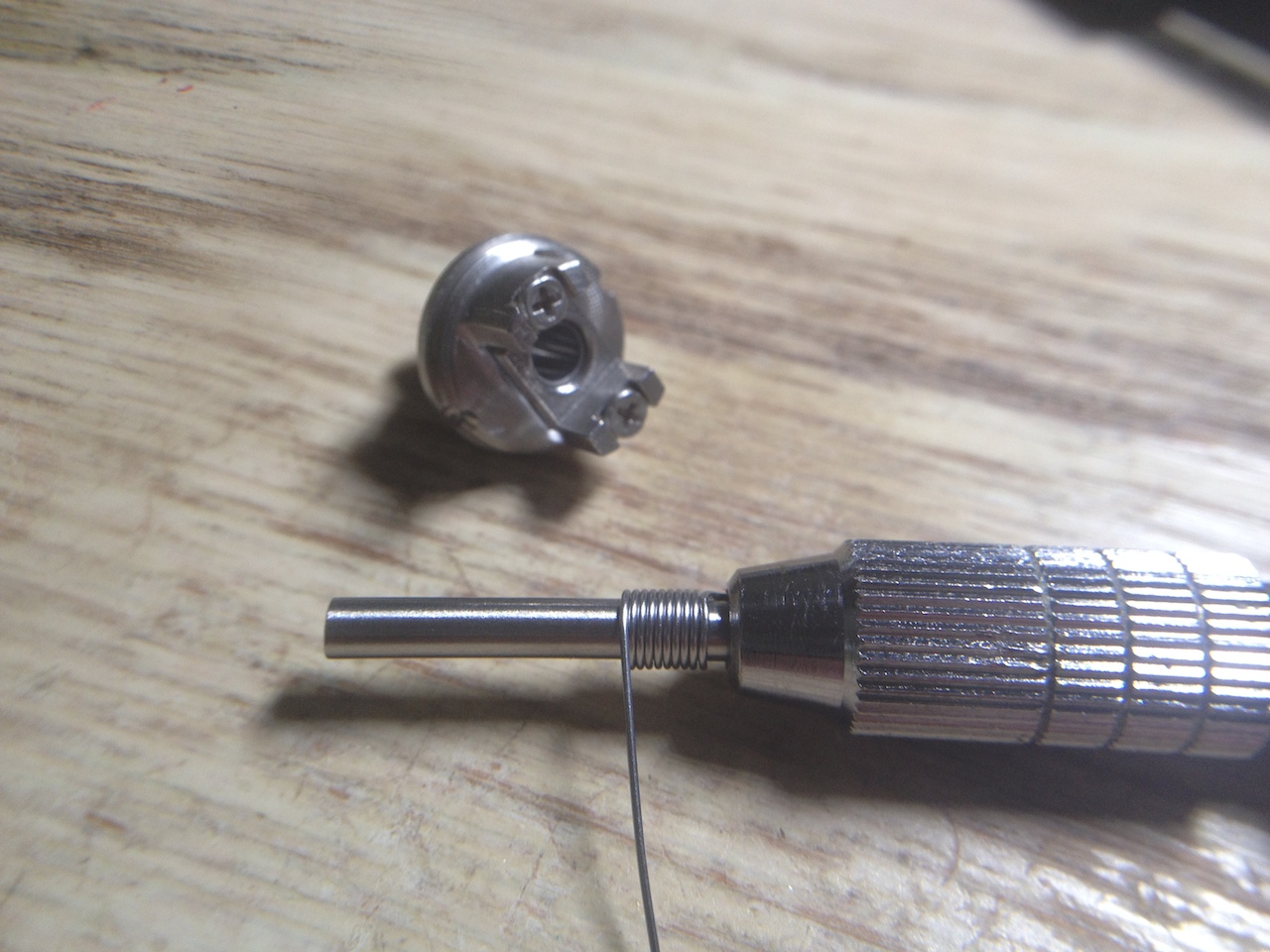
If I had a 2.5mm rod I'd prolly try the gizmo again Mac :). But that is a good eye bother. Damn. That set was wound on a pin vice with a coil master rod inserted in it :)
 
  • Like
Reactions: MacTechVpr
Status
Not open for further replies.

Users who are viewing this thread