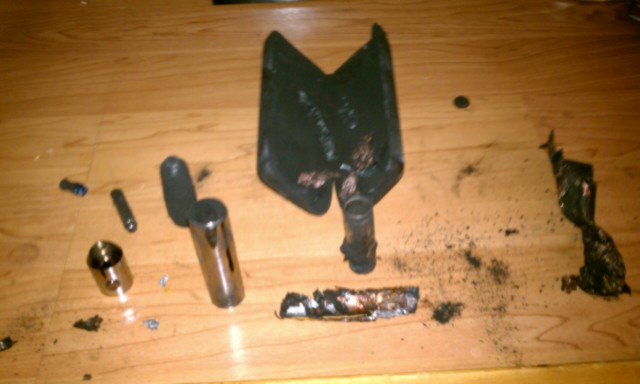
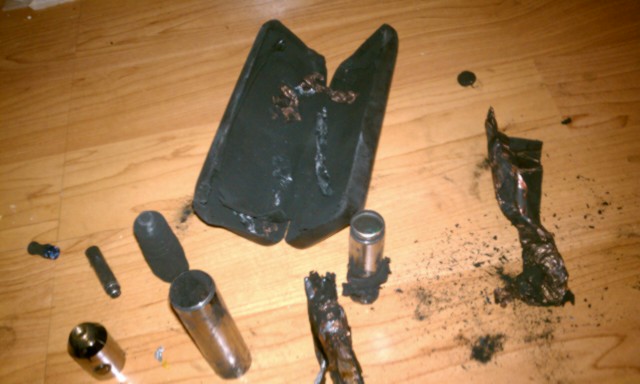
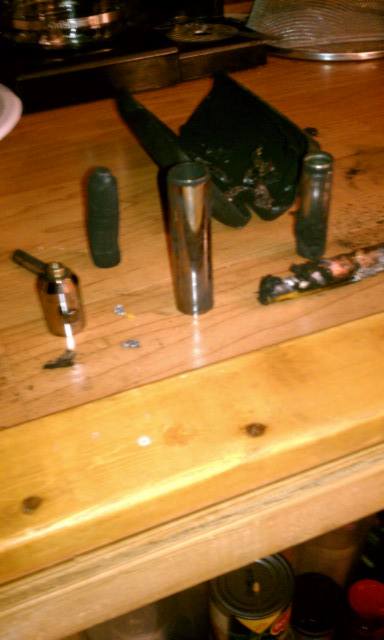
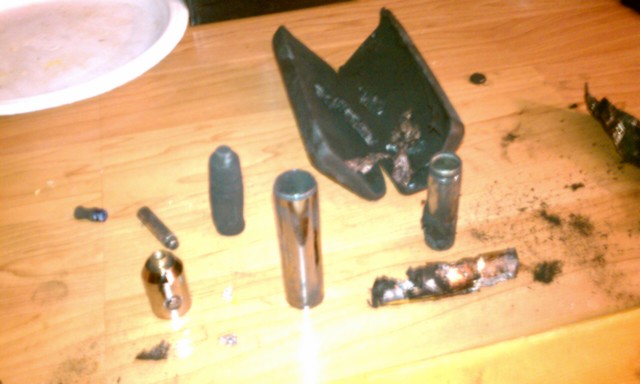
Education is key here and we need to not only be educated on the batteries themselves, but also the chargers we're putting them in. Even with vast amounts of knowledge on these subjects, "stuff" can happen. Still...the more we know, the better chance we have of staying safe.

Here's some more information I dug up on batteries relating to use in mods:
Advantages of Li-ion batteries:
- Low self-discharge rate.
- No memory effects.
- Long service life, about 200 - 300 recharges.
- Cheap compared to some types.
Disadvantages:
- Poor high-current discharge performance.
- Applications that require high current (like e-cigs) will shorten the life of the battery.
- Unprotected batteries might be used by mistake, these are dangerous in high-current use mode, they can AND DO explode.
- The protection electronics can fail due to being zapped by static, or a faulty charger - so the battery is rendered unsafe and there is no indication of this.
The protection circuit on a protected Li-ion battery can fail, so an Li-Mn or LiFePO4 is intrinsically safer.
IMR Li-MN rechargeables
Manufacturers include AW and BDL. AW are reported as higher quality. These batteries are unlikely to explode in use. They are recommended in place of Li-ions and do not need protection. However there are cautions with these batteries:
- They have a high current discharge potential and therefore it may be wise to have a protection circuit in the main device. The discharge rating is 8C, meaning it is likely that a lot of amps would be available if the battery were to be short-circuited.
- They will be overcharged by old-technology chargers and may burst.
- Overcharging (>4.25 volts) will shorten the service life, which is 500 charges under ideal conditions.
- Discharging below 3.6 volts will shorten the service life.
- No memory effect.
- Ideally a charger specifically for these cells should be used.
- These batteries are of high quality and are therefore expensive - but you get what you pay for.
- If you run a Li-Mn down below the minimum discharge voltage, the cell can be damaged. As there is no 'trip out' as with a protected Li-ion, this is a concern.
LiFePO4 rechargeables
These lithium ferrous phosphate batteries have a safe chemistry. LifePO4 is a newer technology and more expensive than Li-ion. This is a safe technology and they don't need any protection. AW batteries make these, and they are a very good choice as they are capable of taking the high load of an e-cig. They come in the same form-factor as the Li-ions used in ecig mods and are an excellent substitute, preferable in all ways except for the cost - however, note the caution below. Notes:
- Do not connect in parallel.
- 2 cells max in series.
- Very long service life of 1,000 charges, under ideal conditions.
- No memory effect.
- Discharge rate is 10C+ so they will certainly power atomizers effectively - but short-circuits need to be guarded against. The 26650 cell for example can put out 70 amps in a dead short.
- Fast recharge.
- Nominal voltage (type 1 eg CR123 format) = 3.0 - 3.3v, min. discharge v = 2.8v, max. charge voltage = 3.6v; nominal voltage (type 2 eg AW 14500)= 3.6v.
- Needs a special charger - different for the two types.
AW LiFePO4's are reported as being the best. They have a much higher discharge rate than Tenergy ones for example - the small Tenergy cells may not be up to the job.
We have one report of a LiFePO4 failure in a mod. It might have been due to the reason given below.
CAUTION: most LiFePO4 batteries have a working voltage much lower than the Li-ion equivalent - 3.2 or 3.3 volts - and they CANNOT be used with Li-ion chargers. AW do make a 3.6 volt LifePO4 battery (their 14500 model) but this is not the norm for LiFePO4. There is a very good chance that some users of LiFePO4's will overcharge them, leading to failure, since the MAXIMUM charge voltage is 3.6 volts but the common Li-ion chargers put out 4.2 volts.
Because of this, AW's Li-Mn rechargeables are thought to be the best option for mods.
Do NOT EVER place 3v batteries in a 3.6v (normal) charger. LiFePO4's are 3v batteries.
Ni-MH rechargeables
These are the stock rechargeables found on main street. They come in the usual AA and AAA formats. Their voltage is just 1.2 volts per cell, so 3 or 4 cells in series are needed for e-cigarette use. They are a safe technology and do not explode with mild abuse. No protection circuitry is needed. A mod can be built very successfully using these standard rechargeables.
They can safely deliver high current to an ecig atomizer. There are some minor disadvantages (shorter life etc) but on the whole they can be used successfully. Each cell delivers 1.2 volts, so some adjustment of the battery numbers / arrangements has to be made. For example 3 in series will provide 3.6 volts (perfect for normal e-cig use), and 4 in series gives 4.8 volts (5 volts essentially). These standard rechargeables are a good choice for mods that are built for the form factor and voltage requirements.
Pros:
- Can deliver high current better than Li-ion.
- Available anywhere.
- The multi-cell battery holders found in electronics stores can easily be used as a boxmod basis.
- Safe technology, no explosions even when stacked.
Cons:
- In theory, a shorter service life. This has not been found to be the case in ecig mod tests though, as many Li-ions don't last long in practice.
- Lower voltage so more cells are needed - at least 3 cells in series.




 )
)


