4.9V with 2.2 ohm atty at 10.91 Watts and 2.22 Current or
6.0V with 3.3 ohm atty at 10.91 Watts and 1.82 Current
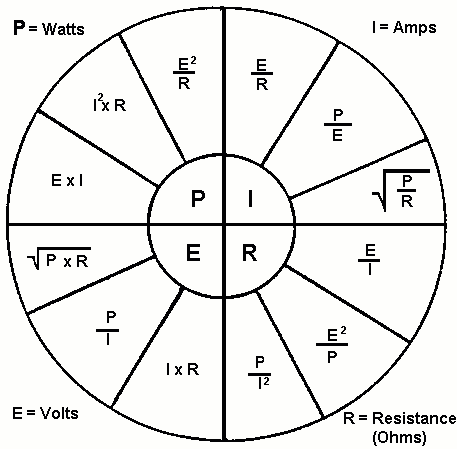
Those numbers are correct and follow Ohms Law. They also follow the law of the conservation of energy. The numbers are very literal but in our application IE any VV Mod, they can not be applied literally. Here is a chart that describes the formulas for ohm's law:
You can do the math yourself now by using the formulas on this chart and you'll see that the statements that you quoted above are correct.
(Voltage or V or sometimes E) 4.9 divided by (Resistance or R) 2.2 equals 2.22727 (Current or I) so actually this one would be 2.23 Current but that's picking at nits. Once you have this number for I or current in amps you can use it to get the number for P or power in watts. It all works and is all very literal but it's a simplistic answer that they gave you.
Now for the confusing part. The examples that you provided above imply a 6V battery and a 4.9V battery. We're using neither of those in the ProVari. Instead, the voltage regulator takes our 3.7V battery and by a conversion process draws a higher current from the battery than normal as compared with the example loads/batts you provided. It has to draw a higher current from our battery because of the law of conservation of energy. You can't create or destroy energy but you can convert it. In order to produce the higher voltage than what the battery is rated at, you pay for it by drawing more current. That MORE current is converted into a higher voltage.
Now to further confuse you... <grin> The regulator is not 100 percent efficient at this conversion of energy. Some of the energy used to create that higher voltage is dissipated as heat. It's the electrical equivalent of friction which most of us understand more easily.
Therefore, there is a loss that is not included in your example situations above. That makes the examples for OUR application on a ProVari unintentionally deceptive.
Since you're wanting to figure this out I'm trying to point you in the direction but without seeing the spec sheet on the regulator used in the ProVari, it's impossible for me or anyone other than the folks at ProVari to know all of the variables that play on this situation.
I personally have not tested the duration of a charge at the two examples you gave us but off the top of my head..... neither one would last much longer than the other because the efficiency of a regulator is not a straight line. It will have a higher efficiency at one voltage than another voltage and at one current than another current. You might get 95 percent efficiency at one voltage and 78 percent at another voltage. At the same time, a higher current draw or lower current draw can affect those percentages all at the same time. This is why electronics manufacturers provide data in the form of charts revealing this information about a parts efficiency. With THAT information, you can apply it to your situation and determine what your requirements and results will be.
To find the atty/voltage configuration that will give you the longest battery life, you will need to have access to the efficiency charts of the regulators manufacturer or do your own independent testing. OR find someone that has tested your two example scenarios in real world tests.
I know this was a long answer to your question "which variables to consider in order to make appropriate calculations" but if you got a short answer it would be impossible to understand what's needed to accomplish your goal.
Here's the short answer... without the spec sheets for the regulator in the ProVari, you can not. I typed this out because you seem to genuinely want to know and I want to help you get there.
I hope I provided more help than harm. <giggle>
EDIT: While I was typing that, Zen~ gave the best answer in my opinion "Think less... vape more!" and I agree with Zen~ but... sometimes we are in a quest for knowledge and deserve an answer.


 instant classic