

You are using an out of date browser. It may not display this or other websites correctly.
You should upgrade or use an alternative browser.
You should upgrade or use an alternative browser.
Molehill Mountain Art - Part II
- Thread starter Kayte
- Start date
- th_trl_thread_readers 0
- Status
- Not open for further replies.

Quick hello..all with nasty weather just hunker down and stay safe. It's going to be very cold here this week but don't think we have to worry about any precipitation.


Hey MerryH..Ol Ziggy and his bud reminds me of how it was in my bar hopping days..The morning after.

Good morning mountaineers[emoji4] Hope y'all are well.
Preparing for an impending snowstorm here-yuck. [emoji13]
We southerners be like

Sent from my iPhone using Tapatalk with my paws
Mommabird62
Bwahahaha..so true.
Ziggy's swag..cute!
Please remind me SWAG doesn't always stand for Scientific Wild Azz Guess every now and then Smiley okay?
Good morning all
Sorry I didn't check back last night, the forum was giving me fits and I left
Yes Chooch, I'm still working quite a bit; we're getting lots of beef brought in
Believe it or not I'm in need of some shorty tips! Dark blue, cherry red, and another color that I can't rememberProbably something for this fuchsia istick ... so hard to match


Yes I didn't come back either..was going to look for a meme for your last comment but couldn't find a decent one that wasn't gross. Beans


Last edited:


Yes I didn't come back either..was going to look for a meme for your last comment but couldn't find a decent one that wasn't gross. Beans
Hi sweetie  That's okay, I slept well
That's good hon..I actually did once I turned the electric blankee up to 6.
Must still have that funk Idk?!?

So, far no snow or sleet and 35 degrees outside right now. Just some liquid rain. Knoxville, 100 miles north of us, got sleet/freezing rain today. Don't mind being "bypassed". Hubbs had the roads and shops to himself when he did a bit of shopping. Couldn't believe it. Firgured everyone had gotten their survival supplies during the weekend and were "hunkered" down.
Meanwhile, I'm thinking......Zilgar's Patch/Place/Corral, Ziggy's Goodies,....... Also, trying to find exactly where my uncle died in the very early part of the Korean War in 1950. If anyone can find Hill 189 near Yongsan, let me know. He enlisted at 15/16 yrs and died at 18 yrs., 7 mos. Name was Robt. W. Bennington, and will have to request from the National Archives any papers that survived the fire of 1973. THAT will take at least 90 days for a reply of some kind.
Hope you all are as "snug as a bug in a rug" and weathering the weather just fine.......Right now, I'm just happy I live in the south.
Meanwhile, I'm thinking......Zilgar's Patch/Place/Corral, Ziggy's Goodies,.......
Also, trying to find exactly where my uncle died in the very early part of the Korean War in 1950. If anyone can find Hill 189 near Yongsan, let me know. He enlisted at 15/16 yrs and died at 18 yrs., 7 mos. Name was Robt. W. Bennington, and will have to request from the National Archives any papers that survived the fire of 1973. THAT will take at least 90 days for a reply of some kind. Hope you all are as "snug as a bug in a rug" and weathering the weather just fine.......Right now, I'm just happy I live in the south.
Hope you all are as "snug as a bug in a rug" and weathering the weather just fine.......Right now, I'm just happy I live in the south.
We live in the South Chooch and have an inch of ice out there

So, far no snow or sleet and 35 degrees outside right now. Just some liquid rain. Knoxville, 100 miles north of us, got sleet/freezing rain today. Don't mind being "bypassed". Hubbs had the roads and shops to himself when he did a bit of shopping. Couldn't believe it. Firgured everyone had gotten their survival supplies during the weekend and were "hunkered" down.
Meanwhile, I'm thinking......Zilgar's Patch/Place/Corral, Ziggy's Goodies,.......
Hope you all are as "snug as a bug in a rug" and weathering the weather just fine.......Right now, I'm just happy I live in the south.
Find a topographical map of that AO Chooch..The hill would be 189 meters high.
!" ice that will be gone by next week vs. Boston's 7 1/2' of snow that won't be gone 'til spring. Dale, I've got to think on that one.
Sirius, thank you. I did find out today how they numbered the hills and did search for maps. No such luck. Will continue looking. All this military stuff has got my head swimmin'.
Sirius, thank you.
I did find out today how they numbered the hills and did search for maps. No such luck. Will continue looking. All this military stuff has got my head swimmin'.
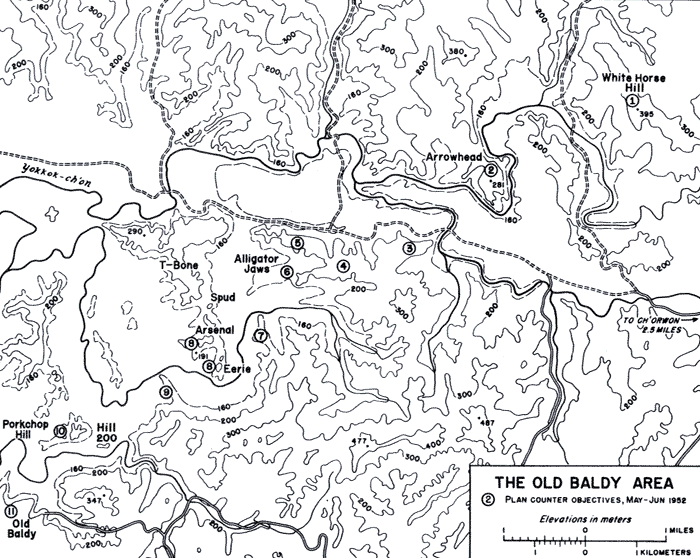
Example:
If he were in the 45th Inf Div you could look that up on wiki as I just did..One never know what one will find in the old wiki..lol

A soldier of the 120th Engineer Battalion, 45th Infantry Division sets up camouflage net near the front lines in Korea in 1952.
On 1 September 1951, the 45th Infantry Division was activated as the first National Guard division to be deployed to the Far East theater since World War II.[87][90] Nevertheless, it was not deployed to Korea until December 1951, when its advanced training was complete.[88][91] Following its arrival, the division moved to the front line to replace the 1st Cavalry Division, who were then delegated to the Far East reserve, having suffered over 16,000 casualties in less than 18 months of fighting.[92]
Though the 45th remained de facto segregated as an all-white unit in 1950,[93] individual unit commanders went to great lengths to integrate reinforcements from different areas and ethnicity into their units.[94] By 1952, it was fully integrated.[95] Additionally, in an effort to reduce the burden on the National Guard,[n 2] troops from the division were often replaced by enlisted and drafted soldiers from the active duty force. When it arrived in Korea, only half the division's manpower were National Guard troops, and over 4,500 guardsmen left between May and July 1952, continually replaced by more active duty troops, including an increasing number of African Americans.[96] Though the division was no longer an "All-Oklahoma" unit, leaders opted to keep its designation as the 45th Infantry Division.[97][n 3]
By the time the division was in place, the battle lines on both sides had largely solidified, leaving the 45th Infantry Division in a stationary position as it conducted attacks and counterattacks for the same ground.[98] The division was put under the command of Eighth Army's I Corps for most of the conflict.[99] It was deployed around Chorwon and assigned to protect the key routes from that area into Seoul. The terrain was difficult and the weather was poor in the region.[100] The division suffered its first casualty on 11 December 1951.[101]
Initially, the division did not fare well, though it improved quickly.[88] Its anti-aircraft and armor assets were used as mobile artillery, which continuously pounded Chinese positions. The 45th, in turn, was under constant artillery and mortar attack.[102] It also conducted constant small-unit patrols along the border seeking to engage Chinese outposts or patrols. These small-unit actions made up the majority of the division's combat in Korea.[103] Chinese troops were well dug-in and better trained than the troops of the inexperienced 45th, and it suffered casualties and frequently had to disengage when it was attacked.[104]
In the division's first few months on the line, Chinese forces conducted three raids in its sector. In retaliation, the 245th tank Battalion sent nine tanks to raid Agok.[98] Two companies of Chinese forces ambushed and devastated a patrol from the 179th Infantry a short time later.[98] In the spring, the division launched Operation Counter, which was an effort to establish 11 patrol bases around Old Baldy Hill. The division then defended the hill against a series of Chinese assaults from the Chinese 38th Army.[98]
Yep, been looking and reading and looking, Sirius. Even read a bit about the Old Baldy area, but that was a couple of years after the Sept. 1950 period I'm looking at.
Even read a bit about the Old Baldy area, but that was a couple of years after the Sept. 1950 period I'm looking at.
Wow this stuff is so interesting! How did you get started chooch?
Sent from my iPhone using Tapatalk with my paws
Mommabird62
Sent from my iPhone using Tapatalk with my paws
Mommabird62
Earlier today-was sitting in my recliner by the woodstove. Three dogs piled on and the fourth one on the back of the couch watching it snow. [emoji6]

Sent from my iPhone using Tapatalk with my paws
Mommabird62
Sent from my iPhone using Tapatalk with my paws
Mommabird62
We live in the South Chooch and have an inch of ice out there
Be safe and warm Dale! Ice don't play. Ours started out as snow then switched to a mix [emoji15]
Sent from my iPhone using Tapatalk with my paws
Mommabird62
Be safe and warm Dale! Ice don't play. Ours started out as snow then switched to a mix [emoji15]
Stayed inside all day momma ... except for once when I threw some trash out. Got icey water dripped on my ear!

- Status
- Not open for further replies.
Similar threads
- Locked
- Replies
- 8K
- Views
- 256K

- Replies
- 872
- Views
- 35K

- Locked
- Replies
- 384
- Views
- 32K

- Replies
- 822
- Views
- 32K
- Replies
- 15K
- Views
- 548K
Users who are viewing this thread
Total: 2 (members: 0, guests: 2)